Showing posts with label sloan-c. Show all posts

Sunday, April 13, 2014

#ET4Online 2014: A Year of Awakening?


Created with Haiku Deck, the free presentation app


Yesterday, I returned from three days at the Sloan-C/MERLOT Emerging Technologies Symposium for Online Learning in Dallas. I am still processing! But here are some reflections.

My key take away at this moment -- aside from reflecting on the deeply amazing humans I met and spent time with -- is that some of the significant organizational changes that have been bubbling up throughout higher education surfaced in different ways this year. This is good! I felt that the presentations this year were topical and compelling. In short, there was discomfort and debate -- more so than in previous years. This too is good! Some presentations even delved into subjects that have become indiscussable at some institutions. And that, to me, is a significant moment in the process of organizational change. 

According to Argyris (1999), when individuals in an organization are confronted with change they find themselves forced to deal with topics or issues that challenge their traditions.  These traditions are governed by mental models, which are undetectable, yet salient, conditions that inform how a person thinks and acts. 

When a mental model that guides a tradition in an organization is challenged, a person will behave in one of two ways. Most commonly, a person will exhibit defensive behavior. Defensive actions may include exhibiting signs of frustration or simply avoiding the topic all together. For example, "That's not how we do things here" or "That wouldn't work because..." These behaviors build upon each other and after enough repetition, the members of an organization become familiar with the expected response and stop raising the topic. The questions (that is, the new ideas, the innovations, the curiosity) stop being introduced into the organization and the status quo is reinforced.  The topic, therefore, becomes indiscussable and the tradition, whatever it may be (even if we all dislike it) remains intact.  We all have seen this right?  Think about when a new person in your organization is hired and asks that uncomfortable question that nobody else asks anymore because everyone else has learned the answer.

 If defensiveness can be overcome when a person becomes aware of his/her mental model, however, the mental model can be seen in a new light. A person can begin to think critically about why and how it became so powerful and start to have a deep conversation about alternative actions. This is when an organization begins to become a learning organization.  This is when awakening can lead to meaningful changes. And it starts with conversations about difficult topics.


Reclaiming Learning


First, Jim Groom @JimGroom shared an important keynote that I both think and hope awakened the minds of many attendees.  View the Storify archive of Tweets here. 

Groom's keynote to me, illustrates, the model of organizational learning I described above. Groom's talk took the audience through a historical look at web culture when geocities offered users the opportunities to easily cultivate their own web presence and connect with others.  This open, communal experience was contrasted with the LMS, higher education's "go to" learning landscape.

It is as if we don't even think beyond what's outside the LMS today in higher education. It is as if we think we're teaching online but we aren't -- we're teaching inside a walled garden.  And how does learning inside an LMS prepare a student for live in our digital, mobile society? These were some of Groom's points.

The LMS has become our tradition. The open-web has become the uncomfortable change -- the flood waters that the administrators of our institutions try to keep out. This is the indiscussable topic that Groom took hold of in his keynote. 

Throughout the past several years, I have worked with many faculty who have shared with me that they want to teach with this tool or that tool to promote more engaging, collaborative learning for their online students but their institutions will not allow them to because of this or that.  Or they immediately pause and become filled with caution and concern at the thought of integrating a tool into their students' learning that is not included within the LMS.

I realize my words may be stirring up emotions within you as you read this and I am fully aware there are topics to discuss and learning that needs to happen in order for us to facilitate learning with web-based tools (which is the crux of my book, Best Practices for Teaching with Emerging Technologies).  The point is that we can work through these topics together, as a community of online educators, if our top priority is our students' learning, as opposed to maintaining and controlling them. 

Groom's points dug deep. If we teach inside an LMS and only inside an LMS, are we truly teaching "online"?  If our students only experience interactions within the controlled, secure walls of an LMS, are they truly experiencing what it means to be online? Are we, as educators, leveraging the educational benefits of the internet if our learners do not engage in activities outside the walled garden of an LMS?  Are we as a system of higher education embracing even a small percentage of the power of this "learning revolution" we appear to be occurring around us?  How is learning online improving students' abilities to think critically about media? To create original media and share it for re-use in a digital, mobile society? To locate, evaluate, and re-use media effectively?

And as we, more and more, strive to design "learner-centered" online learning environments, the LMS is designed to lock students out from their own learning contributions after a term has ended.  As Groom so eloquently put it, when students learn in an LMS, they learn in an environment that has no relevancy to life after college.

As I reflect on my own teaching, the more I have ventured outside the LMS to designed an online learning environment for my class that incorporates a tapestry of student-centered media projects with web-based tools the more inspired, relevant,  and active my students' learning has become. And that topic has been the premise of this very blog, my book, and my other related work.  In fact, I became so passionate about this topic that it led me in 2009 to leave my safe, tenured position as a full-time faculty member and eventually begin my life that same year as a free-lancer. In many ways, teaching outside the LMS led me to a life as an academic outside the academy. Hmm. Interesting connection.

The LMS is a helpful tool for providing a secure place for having students authenticate as registered students. That is a function I rely upon it for. The LMS is also a valuable tool for communicating grades to students, which must be done securely to comply with FERPA.  I also use my LMS to deploy periodic traditional assessments for learners, because they provide students with automated feedback from me, as well as opportunities to learn from their mistakes when assessments are allowed to be taken multiple times. 

I have much more processing to do about Jim Groom's talk. But, for now, I'd like to thank him for taking us to this level of learning.  

Mess in Online Education

Image by Cy Twombly
The plenary presentation at #ET4Online, Mess in OnlineEducation: How It Is, How It Should Be, was delivered by Jen Ross @jar and Amy Collier @amcollier.  Their presentation reframed the culturally derogatory term "mess" into a positive vision for online education.  Yes, your teaching should be messy.  Why?  As the presenters reminded us, learning is messy.  If we could visualize how each of us learns, we would be able to see that each of us learns in an entirely different way. I was reminded of a Cy Twombly drawing while listening to this presentation. Some may see it as a mess; some see it as beautiful. Either way, it's art.

But mess is more than supporting learning differences.  Mess involves designing for and allowing for learners to experiences the challenges, stumbles, and failures involved with the real world, as well as building in flexibility to allow life to intervene. Right now, my online students are embarking upon a project that involves locating a practicing art photographer (anywhere in the world), interviewing him/her about his/her work, and creating a VoiceThread about the photographer's work.  I have this project chunked out into three steps, each with a deliverable, clear criteria, and a due date, to keep students on task.  The experience is different for each student. For example, some students identify a photographer quickly, others reach out to several before they make contact with one who is available to be interviewed, and I have had two students (over two years) who have needed my help finding a photographer. Most students relish in how incredible it felt to be in touch with a "real" photographer and learn about his/her experiences. Some have maintained connections with them and even been sent prints from the photographer after the project's completion. One photographer asked my student's permission to share her VoiceThread on his blog (nice turn of the tables!) and another student received an email from a photographer letting her know that her project had "validated his career."

The project is messy. I never know how it's going to turn out or what problems we are going to encounter. The important thing is that my students know I'm in it with them and I'm there for them -- and that they remain in communication with me. I have had semesters where I've thought, "Maybe I should end this." But after listening to Amy and Jennifer's presentation, I feel empowered to continue this project.  It truly is real-world learning that will foster skills for life, more so than any multiple-choice test, discussion forum, or assigned blog post.  Learning outside the LMS is real world learning. And that is why we need to embrace it.

In the presentation, Collier and Ross also noted one recent trend in edtech that is discouraging mess in online learning -- the proliferation of technologies that simplify the teaching and learning process.  In their presentation, they included many screenshots from promotions and writings about products that promote their ability to save teachers time, to minimize assessment challenges, etc.  While I agree that the focus on lifting the teacher from the student experience has been overly celebrated in the MOOC heyday -- and I shared early reservations of employing MOOCs widespread in community colleges here -- I hope the presentation does not throw cold water on the many innovations surfacing in educational technology today that will continue to improve upon the sterile, tidy LMS-driven experiences Groom critiqued in his presentation.

As I already noted, it were not for the emergence of web 2.0, I would never have ventured outside my LMS.  I would still be teaching my visually-centric art history courses using text-based discussion forums (ouch).  I enjoy not only the opportunity to continue to explore new tools emerging on the edtech horizon, but working directly with entrepreneurs who want to learn how to improve education.  I support more dialogue between higher education and edtech startups -- not less.  Entrepreneurs need to learn from online educators --. and those who will survive are those who are willing to learn.

Questions for reflection:

  • "How is your online class preparing your students for success in the 21st century?"
  • "How does the design of your online class generate opportunities for students each go different ways, encounter unique challenges, and identify their own solutions?"

Thinking Ahead to 2015

Next year, I will be conference chair for the 2015 Sloan-C-MERLOT ET4Online Symposium.  The event will be in Dallas once again on April 22-24, 2015.  Send me your ideas and your suggestions so it can continue to be an engaging, thought-provoking experience and advance the conversation about the role of emerging technologies in online learning.


References:

Argyris, C. (1999). On organizational learning. Malden, MA: Blackwell Business.

Wednesday, February 5, 2014

7 Reasons Why You Should Join Us in Dallas for #ET4Online

In case you're wondering why you should register for Sloan-C/MERLOT's 7th Annual International Symposium of Emerging Technologies for Online Learning in Dallas this April 9-1, 2014, here's 7 darn good reasons.

Early bird registration closes February 10th. Hope to see you in Dallas!

Thursday, January 16, 2014

2013 Babson Report: More Online Growth in U.S. Higher Ed


This week, Sloan-C shared the 11th Annual survey about online learning in higher education in the United States, a collaboration between the Babson Survey Research Group and the College Board, Grade Change: Tracking Online Education in the Untied States, 2013. The report surveyed the opinions of academic leaders at more than 2,800 degree granting institutions of higher education across the United States. at I have prepared some highlights and shared some deeper reflections about the study. 

A bird's eye view.

The data demonstrates a continued and consistent shift from brick and mortar learning into a college learning experience that provides students with options to learn in a physical classroom or online.  In United States higher education in 2013:
  • 7.1 million students or 33.5% took at least one online class
  • there were more than 411,000 additional students learning online

What does this mean in context to overall higher ed growth rates?  

  • In 2002, only 1.6 million students took at least one online class in higher education in the U.S.  The change from 2002-2012 represents a compound annual growth rate of 16.1 percent. Overall (all modalities of learning), overall U.S. higher education enrollment has grown at an annual rate of 2.5 percent during this same period. 

How have academic leaders' values changed about online learning? 

  • The way college and university academic leaders value online learning has changed significantly in the past eleven years.  In 2002, less than half of all higher ed institutions surveyed agreed that online learning was strategic to their long-term success. In 2013, close to 70% of institutions agreed, an all time high.

What Does the Crystal Ball Say?  

  • Academic leaders agree that online enrollments will continue to grow in the future. 
  • Ninety percent believe it is likely or very likely that a majority or all of higher education students will take at least one online course by 2018.  Currently, this figure is at 33.5%.

What's up with MOOCS?

  • Fifty three percent of institutions are undecided about MOOCs and 33% have no plans for a MOOC. These figures reflect little to no change from 2012, despite the deluge of press coverage MOOCs have experienced.
  • Leaders at institutions offering MOOCs supported the following three objectives most for implementing them: 
    • Increase Institution Visibility (27%)
    • Drive Student Recruitment (20%)
    • Innovative Pedagogy (18%)
    • Flexible Learning Opportunities (17%)

Retention is an issue. 

  • Forty one percent of academic leaders noted that retaining online students is more of a problem than it is in face-to-face classes.  This number increased from 27% in 2004.  The leaders were not asked to speculate why.

Which institutions offer the most online courses?

  • Associate degree granting institutions offer far more online courses than any other type and have the most positive view of online learning.  Baccalaureate institutions have the most negative view about online education and represent the largest institutional type with no online offerings. Last year's 2012 study demonstrated that attitudes about online learning change when more online course are implemented into an organization and the realities of the online paradigm begin to be experienced (Changing Course, 2012).  For example, 18% of academic leaders at institutions without online offerings disagreed that it takes faculty more time and effort to teach an online course; whereas, only 9.7% of academic leaders at institutions with online courses disagreed with this statement.   
You may request to download the entire report from Babson here.
p.s. I missed the cool infographic that was developed and shared with last year's report.

Thursday, October 3, 2013

The Launch Pad: What it is & Why it's Important

The Launch Pad (#LaunchPad)

Sloan-C MERLOT Emerging Technologies Symposium for Online Learning

April 9-11, 2014 in Dallas, TX

As emerging technologies continue to open new opportunities for improving education around the world, increasing the interaction and learning between educators and edtech entrepreneurs becomes more essential.  The gap between the minds that conceptualize and create the tools and the minds who facilitate teaching and learning must be minimized to increase the quality of emerging technologies moving forward.  If constant efforts are not made to bridge this gap, edtech startups will well, in the finessed words of Reynol Junco, "suck."

In the past several years, there have been an array of new "spaces" that have brought startups and educators closer together including Educause's Start Up Alley, SXSW LAUNCHedu, and the no fluff, no frills (meant in a good way) events put together by the dynamic community at EdSurge which includes the upcoming K12 EdSurge Tech for Schools Summit in Silicon Valley scheduled for November 2nd.  Each of these events acknowledge that we are all learners.  Entrepreneurs are business people with a quest to be successful and, yes, be profitable but to do so with the goal of developing a product that meets the needs and interests of real teachers and students.  Educators are continuously learning about the newest tools available to them and seeking to identify how they may improve the learning environments they have cultivated for their students.

Last year, the Sloan-C MERLOT International Symposium for Emerging Technologies for Online Learning (@ET4Online) stepped into the learning space, as well by crafting the Launch Pad.  It was a new, refreshing change for the conference and one that we are continuing again this year.

The 2nd Annual Launch Pad is now open.  Early startups in the edtech space are invited to attend the conference and, this year, learn with top online educators and Michael Staton, of Learn Capital.  If you are an early startup with a product focused on improving online learning, consider applying for the Launch Pad.

Applying is free.  Those who are selected will receive a deeply discounted rate to attend and a fabulous array of benefits (see site for details).

The Launch Pad application period closes on January 31, 2014. 

Thursday, September 12, 2013

Call for Proposals Open for Sloan-C Emerging Technologies for Online Learning Symposium (ET4Online)

Five and a half years ago, I attended the first Sloan-C International Symposium for Emerging Technologies (ET4Online) in Carefree, Arizona. It was an awesome event -- I fondly recall the energy and conversations wrapped around hot new technologies like the Flip camera, Second Life, open educational resources, podcasting, and iTunes U.  I shared my reflections in a blog post here.

Since then, technologies sure have changed! That first event was actually before the release of the first iPhone.  Who could have imagined how quickly hand held, internet connected computers equipped with collaborative, enticing apps would reshape the way so many of us communicate, the experience life, complete simple tasks, validate data, organize groups, document the world, and, of course, rearticulate who we collaborate with.

I have attended every one of the six ET4Online symposiums and I am thrilled to be the Chair-Elect for the 7th Annual Sloan-C/MERLOT International Symposium for Emerging Technologies which will be held in Dallas, TX on April 9-11, 2010 at the Sheraton.

The ET4Online Call For Proposals is now open until November 1st 
This date will not be extended

The tracks for this year's conference include:
  • Learning Environments
  • Open Education
  • Evidence-based Learning
  • Faculty and Student Development
  • Innovative Media and Tools
Visit the CFP site for more details!

Whether you consider yourself a novice, intermediate or expert in this area, I hope to see you in Dallas. In the field of emerging technologies, there are so many opportunities for us all to learn from one another to understand how today's new technologies are impacting online teaching and learning.

Thursday, April 4, 2013

Launch Pad Participants Revealed for #ET4Online!


Next week, innovative online educators will comingle with some of the hottest entrepreneurial minds in educational technology to foster an additional bridge between the world of business and formalized education.  Fostering more formative feedback loops between these frequently silo'd sectors of society is becoming more and more critical as technology continues to present compelling solutions to old teaching and learning problems and paint exciting visions for the future.  Ensuring today's entrepreneurs are in dialogue with today's educators is critical to the success of teaching and learning.  And that is the objective of the Launch Pad, the brand new program included in next week's Sloan-C/MERLOT ET4Online Conference in Las Vegas, which I have had the honor of chairing this year.

Eight outstanding startups have been selected to participate in this year's inaugural Launch Pad. They are listed below.  A representative group of the participants will participate in a plenary panel at the conference on Thursday, moderated by EdSurge's Tony Wan.  If you are attending the conference, please be sure to come by the Launch Pad, explore the creative genius of these products, converse with the creators themselves, share your feedback about their products, and attend the plenary on Thursday morning which will commence immediately following a stimulating presentation by James Byers, co-founder of Wikispaces!
  • BuzzMath: a mathematical mission that leads middle school students to proficiency through supported practice. The student-centered and user-inspired design makes BuzzMath practical and motivational for students and teachers.
  • Ginkgotree: puts the power of curriculum curation back in the hands of the faculty who teach it, to lower students’ costs and improve their learning outcomes. The platform allows instructors to assemble online curricula from any resource, complete with automated copyright clearance and digital content sourcing.
  • HireArt: HireArt is a new type of jobs marketplace that uses online challenge-based interviews to vet job applicants. HireArt screens and sources candidates through work samples and video interviews that simulate what a candidate would do at the real job. 

  • The Predictive Analytics Reporting Framework: a multi-institutional data-mining project, managed by WCET. It brings together 2 year, 4 year, public, proprietary, traditional, and progressive institutions to collaborate on identifying points of student loss and to find effective practices that improve student retention in U.S. higher education.

  • scrible: a tool that lives in your browser that allows a user to seamlessly annotate and comment directly on webpages and save, share and manage them with others. Scrible makes online information usable and manageable.

  • Skyepack: a content-focused educational software environment that is designed to facilitate the delivery of learn-anywhere mobile content as an alternative to texts, course packs, and class handouts. Skyepack enables instructors to easily build mobile-ready learning content from a variety of media and resources, delivering video, audio, documents, self-assessments, and HTML5 applications.

  • STEMscopes: a K-12 comprehensive online science curriculum housed in Rice University's Center for Digital Learning and Scholarship. STEMscopes provides hands-on inquiry activities, assessments, problem-based-learning, intervention tools, acceleration materials, and teacher support resources. Our program is 100% aligned to the Texas Essential Knowledge and Skills (TEKS) and meets the rigor and depth of both the State of Texas Assessment of Academic Readiness (STAAR™) and high school End-of-Course (EOC) assessments.

  • ValuePulse: Social learning platform that harnesses the power of social media to provides one-click access to a credible, curated news library to fuel discussions in a course.  Empowers students to achieve learning objectives by engaging current industry news as opposed to textbooks and understand how to effectively apply social media to their professional lives.

Wednesday, January 9, 2013

Launch Pad: Startups Apply Now for ET4Online


The 6th Annual Sloan-C/MERLOT International Symposium for Emerging Technologies in Online Learning (@ET4Online) has been moved from July to April 9-11 this year in Las Vegas!  Also new to this year's festivities is The Launch Pad, a chance for a small group of leading edge educational technology startups to be featured in a showcase role at the conference for a special price. Read more about the event and the cool ways EdSurge's Tony Wan will be partnering with us on their awesome site here.

I have the great pleasure to be the Chair of the Launch Pad committee this year and it's been an exciting opportunity to cultivate this new dimension into the ecosystem of the conference.  As an online educator myself, I believe the overcoming many of our current educational challenges will require a more fluid dialogue between educators and entrepreneurs.  Those who are envisioning the tools with which we, as teachers, will use to facilitate our learning environments, must understand the challenges and obstacles educators face on a daily basis. The Launch Pad is one step towards improving this dialogue and fostering a learning community between educators and entrepreneurs.

6-8 companies will be selected to attend the ET4OL conference in Las Vegas on April 9-11, 2013. 

The lucky Launch Pad participants will receive:
  • A booth in the specially designated “Launch Pad” area within the conference floor plan
  • Full conference registration (a $575 value)
  • A seat on the “Art of Innovation” conference plenary panel, moderated by EdSurge’s Tony Wan, on the morning of Thursday, April 11th
  • An invitation to attend "The Art of the Startup", a workshop on Tuesday, April 9th featuring presentations by:
  • Spotlight promotions on the ET4Online website and EdSurge newsletter
  • The priceless opportunity to speak with and the world’s leading online educators and learn how to improve your product to meet their teaching needs
  • Special Introductory Launch Pad Price: $400*
(*There is no fee to apply. The fee will be paid by selected participants only.)

Apply for the Launch Pad now! Application period closes January 23rd.


Tuesday, November 15, 2011

Wake Up! It's Time for an Online Learning Reality Check

This month I attended the 17th Annual Sloan-C International Conference for Online Learning in Orlando.  I have shared my reflections this month in a new GETInsight blog post.  I hope you'll join me for a discussion there!


Wake Up! It's Time for an Online Learning Reality Check

Thursday, November 18, 2010

Latest Sloan-C Report on Online Enrollment


Each year, Sloan-C releases a report about the state of online learning in US higher ed.  Last year's report revealed that enrollments from '07-08 increased 17% and there were many that predicted a plateau for the upcoming year.  The data in this year's report, Class Differences, foiled that prediction!
The Shift to Online Learning Continues
US higher ed online enrollments from fall '08-09 increased 21% from the previous year and comprise roughly 30% of all higher ed enrollments.  While the rate of increase year over year continues to reshape enrollments it's important to keep this growth in perspective with what's happening with overall higher ed enrollments -- they remained relatively stagnant at 1.2%, even less than the previous year's total growth which was 2.5%.  This means, each year more and more college students continue to take more online classes and less face-to-face classes.  In 2009, one in three college students was enrolled in at least one online class.
Institutional Planning for the Blended College Experience - what's happening on your campus?
The continued unbundling of our traditional vision of college as a brick and mortar, face-to-face experience to a blended or fully online learning journey will continue to challenge traditional approaches to institutional planning.  If you work at a college or university, I'm curious to know if you hear your college leaders speak/write about online learning in their strategic presentations about the future of your institution.  If they speak or write about a need to plan for "growth," are they envisioning much of this growth to be online and encouraging a bolstering of technological infrastructure in line with increased faculty support for online pedagogy, technological support/training, and accessibility/media specialists; as well as online student services -- rather than "more buildings?"  How is this shift challenging traditional approaches to staffing (for example, does your college hire non-local online instructors?  Do you assess them in some way to ensure they're skilled in online teaching prior to hiring them?  Finally, Is online learning included in your institution's mission statement in someway?  If so, how?


Monday, July 12, 2010

Sloan-C Effective Practice Award Recipient for VoiceThread in Online Learning!

I'm excited and honored to share that my use of VoiceThread in Online Learning to enhance community, increase social presence and improve visual learning is the recipient of a 2010 Sloan-C Effective Practices Award!


The Sloan Consortium is an institutional and professional leadership organization dedicated to integrating online education into the mainstream of higher education, helping institutions and individual educators improve the quality, scale, and breadth of education. 


The Sloan-C Effective Practices are submitted year-round by online educators and institutional teams and are viewable by the public.


Thank you, Sloan-C, for recognizing my contributions to the development of quality online teaching and learning.  I look forward to receiving the award at the ET4Online Conference in San Jose, when VoiceThread will also receive the MERLOT Classics Award.  Steve Muth, co-founder of VoiceThread, has asked me to accept the VoiceThread award on his behalf and we will be co-presenting to the conference attendees on Friday, July 23rd in a featured presentation.  Looking forward to all of it! 


The following VoiceThread showcases the overall practice.  Feel free to comment on any slide.  Please be aware that comment moderation is turned "on" so your comment will not appear immediately.


A full-size view of the same VoiceThread is available here.


Tuesday, January 26, 2010

Sloan-C Survey Says: US Online Enrollments Strong; Strategic Focus Weak


It's that time of the year for me geek out over the annual report released by the Sloan-Consortium, Learning On Demand: Online Education in the United States, 2009. Sloan publishes one such report each year and here are a few startling revelations, highlights, and my own reflections in italics.

As of fall 2009:
  • The US saw a 17% increase in online enrollments in higher ed over the previous year, outpacing the the 12% increase announced in the '09 Sloan-C survey (which stunned folks).
  • The 17% increase in online enrollments becomes even more startling when we compare it to the measly 1.2% growth overall for higher ed (!).
  • While the participating colleges and universities indicated that they had witnessed an increase in all their offerings (all methods of delivery) due to the economic downturn, all institution types agreed that the strongest demand is for more new AND existing online courses as well as online programs.
  • Despite the enormous student demand and strong enrollment growths, college and university executives continue to demonstrate a flimsy, at best, correlation between the importance of online learning and the strategy of their institution. This is a point that I hope is rung clearly throughout our nation. I believe there is a strong, clear disconnect between college and universities leaders and the heart and soul of online learning. Online learning is not IT. Online learning is not a strategy to increase dwindling budgets. Online learning is a new, innovative educational landscape that enables institutions to reach more students and different students in new and exciting ways. But it also requires institutions to encourage, motivate, inspire, and support faculty to learn new and sometimes challenging but sometimes amazingly refreshing and rewarding ways of cultivating learning experiences for our students. If this earth-shattering shift in education that has already begun to revolutionize learning around the globe is dismissed as "not strategically important" at your institution, perhaps it's time to refresh the skills of those at the helm. In fact, it becomes concerning to see our country miss out on such opportunities for global learning when our workforce and overall national economy is thirsty for innovative ideas from 21st century-bred leaders with the ability to collaborate, present, lead, motivate and negotiate virtually and face-to-face with multi-generational and culturally diverse teams. This is our mission, this is our job as faculty, administrators, staff in higher education. And this is the texture of the online learning experience...if one approaches it strategically. Is that not critical to the success of our country, let alone your institution, your future? If this isn't a missed opportunity, I don't know what is. And nobody is screaming about it. SCREAM WITH ME.
  • An exclusion from this year's survey, which is painful to me, is the helpful visual that illustrates which types of institutions are carrying the online enrollments. In past years, I recall learning (and I've cited this countless times, as I believe it's crucial yet completely marginalized) from the Sloan survey that more than 50% of the online enrollments occur at 2-year institutions. I don't see this information included anywhere in the report which I'm quite saddened by. It was the one helpful statistic that I could lean on to leverage the significant role that community colleges are playing in the online learning landscape. Now it's gone. Instead, this year's report simply notes that 82% of the enrollments occur at undergraduate institutions which, to me, dilutes the role of community colleges and inflates the role of 4-year universities. I realize this was not an intentional edit on the part of the Sloan-Consortium, but I do hope they understand how valuable the more specific data provided in earlier years is to community colleges.
  • The report also delved into the intriguing question of retention. The respondents were asked, "Is Retention of Students Harder in Online Classes?" Now, keep in mind the respondents for the survey were executives who, according to the survey, aren't terribly strategic about online learning. So, I'm questioning how informed they are about retention issues in online classes. Nonetheless, I digress...what I found particularly interesting about the response was the breakdown of the respondents "by institution type" (AH HA...they DID collect this info!!) that specifies which institutions acknowledge retention in online classes to be an issue. Take a look at the institution type that has the highest percentage of agrees:
Is Retention of Students Harder in Online Classes?


  • This retention graphic above shows that 36.7% of Associates respondents agreed that retention of students is harder is online classes, while just 19% of 4-year institutions agreed which is a staggering gap in the two types of undergraduate institutions. To me, this statistic alone justifies the importance of researching the trends of online learning at CCs and 4-year institutions uniquely, when possible. Community colleges and 4-year institutions serve two very unique student bodies and teaching online classes at these two different types of institutions raises different issues and requires different strategies for success. I believe understanding where the majority of the enrollments are occurring is a significant item to highlight in a Sloan-C report and now I'm left wondering ... has it shifted?
  • Faculty development/distance learning programs within institutions will also be intrigued by the additional question woven into this year's survey that investigates whether or not faculty are provided training to teach online and if so, what are these methods? Unfortunately, the results of the survey reveal a less than shocking mish mash of internal and external training programs and informal/formal mentoring programs (which, to me, begin to get suspicious of like "faculty help each other and just don't get paid for it" types of "training"), they're still interesting. Here is the graphic that breaks down the results by institution type.
Type of Training for Faculty Teaching Online


Thanks Sloan-Consortium and Babson Survey Research Group for another installment of online data fun!

Wednesday, December 9, 2009

Sloan-C/MERLOT/Moodle Join Forces for Emerging Tech Finesse in San Jose 2010

And it's in MY HOMETOWN!! Do YOU know the way to San Jose?

Mark your calendar!

The 3rd Annual Emerging Technologies for Online Learning Symposium, brought to you by the partnership of Sloan Consortium and MERLOT with MoodleMoot, will be held July 20-23, 2010 at The Fairmont Hotel in San Jose, CA.

Share your expertise at the 2010 symposium!
The symposium focuses on the technologies that drive online learning effectiveness. The conference planning committee is seeking proposals that demonstrate research, application and best practices of important emerging technological tools related to social networking, assessment, open educational resources, new media and support services.

We are also accepting proposals for pre-conference workshops. For additional details on the symposium, presentation submission guidelines and to submit your proposals, visit our website at www.sloanconsortium.org/et4online

Call for Presentations is Now Open!

Submit proposals online by January 18, 2020 at http://et4online.merlot.org/

Things to do in San Jose.

Friday, October 30, 2009

Online Learning: pay it forward

Things are a mess in higher education now and we need new ideas to help us move forward. In my last blog post, I reflected on the loss of California's proud history of higher education which includes magical stories of free community college degrees that opened gateways and fulfilled dreams of socially disadvantaged individuals who, otherwise, would likely have never completed a college education. I received a few comments from that post and several heartfelt emails from individuals who had earned degrees through this "free college" system. The emails were filled with tremendous heartbreak over the recent budget cuts to California's higher education system and, more specifically, how those cuts are impacting students' access to learning.

Of course, we all realize something has to change. First, public education in California, and across our nation, needs more funding in order to ensure our students are provided with access to affordable college education. However, we need more than money. We need new approaches to education; new ways of thinking about connecting our students to learning experiences.

This week was the 15th Annual Sloan-C International Conference on Online Learning. Two years ago, I was awarded with the Sloan-C Excellence Award in Online Teaching, which will remain a highlight of my career forever. Sloan-C has been a leader in the field of advocating for quality online learning since before most educators had even considered the notion of "distance learning." This was the first year since receiving my award that I did not attend the conference. Despite being invited to participate in a prestigious panel discussion titled "Ask The Experts," I was not granted funding to travel to Orlando due to the California budget cuts. Therefore, I was not in attendance this year. That was tough for me, as I feel being part of the international dialogue about online learning is an important part of growth as an educator and an advocate for faculty who teach online.

While I wasn't there in person, I did read an article today in the Chronicle of Higher Ed that featured some thoughts about the conference. Despite the drastic travel restrictions, conference attendance increased from 1,190 to 1,435 people (in person). Frank Mayadas, long time Sloan Program Director, addressed the crowd with a call to action -- a call to meet the demand to retrain Americans who have been laid off and are now in a state of transition seeking new skills for a career change. Online learning opens new avenues of opportunities to students who may be unable to attend a physical class due to other circumstances (which could include a host of topics from child care challenges, work schedules, psychological disorders, physical disabilities, etc.). Online learning is in demand. We know that. It's not a shock. Last year's Sloan-C report, Staying the Course, revealed that 3.94 students in higher ed were enrolled in at least one online class in 2007. That's about one in four students. I'm waiting for a new report to see the new numbers but I'd anticipate these numbers will continue to rise.

What's buried in these numbers is the fact that more than 50% of these online students are enrolled at community colleges. I can attest, from my informal research of observing and listening and conversing the online conferences I've attended across the nation in the past few years, that the large majority of those who attend professional development conferences focused on online learning come from four year universities. Also, having been employed as a full-time faculty member at a California community college for seven years, I can all share that I do not ever recall any community college in California that I came into contact with that had an instructional design team on staff or even a single instructional designer -- thoughts anybody? I'd love to hear from some of you about this topic.

If you are employed at a community college or a university, do you have an instructional design TEAM to support faculty with developing their online courses? What about multimedia support specialists, accessibility specialists, graphic designers, and learning management system staff? What's the faculty support structure like at your community college or university? Let's compare.

Developing online classes is a lot of work. This is not a myth. 85% of faculty with online course development experience agreed that it takes "somewhat more" or "a lot more" effort to develop an online course. The recent APLU survey provides an indepth look at faculty attitudes and opinions about online learning. Most important is their blatant disappointment in their campus support structure (including support for course development, delivery, students, and more). And we need our instructors to maintain a high level of teaching presence in a class for online learning to be high quality. This is where I get concerned.

We have an opportunity right now to put our heads together and support faculty, foster innovation and cultivate communities of course development and shared online content resources that result in online classes with high-touch teaching presence, rather than dull, dry, disconnected content deployed to students through a computer screen -- that's not a quality online course.

Back to Sloan...Frank Mayadas, Program Director for Sloan, has stressed the need for offering more online classes to fulfill the needs of training our workforce. Excellent point. He has also stepped up and encouraged the Obama administration to fund free online courses for community colleges. Perhaps, this is an opportunity to move us back closer to the 1960s free community college education in the California golden state.

This is sounding intriguing, isn't it!?

But the excellence of this plan hinges on whether or not our faculty, the subject matter experts and the human souls that foster and inspire learning, are a core element of the online learning experience. And whether or not instructors are teaching courses that are designed to actively engage students in creative, active learning environments with teacher mentoring and facilitation. It is not acceptable to think of "teaching presence" as a "bottle neck" towards achieving our goal of delivering access to online learning to our student population. Instead, we need to focus on new methods of organizing and funding support for our faculty as an integral element of online programs, rather than a secondary or tertiary afterthought that faculty must fight for.

Frank Mayadas said, "If we’re going to have instructor-led courses, you better get your faculty very enthusiastic, beating on the doors, saying, ‘Give me help. I want to go online.’ And I don’t think we’ve done that." I fully agree. It's time our faculty become empowered to be advocates for the support needed to deliver a quality online learning experience to their students.

And, finally, I also believe it's time higher education begins to foster the value of innovation. How will faculty be encouraged and motivated to try something new, something different -- to take a risk -- when academia is so focused on success? Failure is part of growth and success in a culture of innovation. And if we're modeling innovation and risk taking in our teaching methods but trying new activities and pedagogies, then we're cultivating strong, creative thinkers for the 21st century.

Online learning is our golden opportunity but it's up to all of us to advocate for quality online learning so we pay it forward, rather than open access to dead, irrelevant learning experiences. I hope we play this one right.

Tuesday, June 23, 2009

Sloan-C Emerging Tech Symposium Reflections


Last week I spent three days in the glorious city of San Francisco soaking up new ideas and inspiring messages about the direction of online learning in higher ed at the 2009 International Sloan-C Symposium for Emerging Technologies.

I attended an outstandingly solid pre-conference workshop, Hybrid Learning Meets Web 2.0, presented by three stellar individuals from the Maricopa Community College district: Veronica Diaz, Naomi Storm and Jennifer Spink Strickland. The co-presenters showcased a model of a course "redesign" experience that facilitates the instructional transition from teaching a fully face-to-face course to a hybrid or blended model. The workshop effectively offered participants a treasure box of amazing resources (check out their phenomenal wiki packed with content that they generously shared!) that can be leveraged for implementing similar course redesign models at other institutions. The scalability is much appreciated! Also noteworthy was the blend of tech resources with relevant reflection on pertinent topics. For example, the participants spent time in break out groups defining our own concept of "hybrid" and even trying to decide whether or not our own fictitious institution would adopt the name "hybrid" or "blended." Hmmm -- we really do squabble over details, don't we? The message was clear. Don't jump into a hybrid class or begin to roll out a hybrid program without planning and discussing the pedagogical and conceptual implications with your constituents. Collaboration is key.

The opening keynote speaker on Wednesday evening was Richard Katz, Vice President of Educause, who explored the potential of cloud computing to both transform and rattle the traditions and infrastructure of higher ed IT, communications and pedagogy.

Wednesday's "expert plenary" session included a panel of business leaders that I found most engaging, particularly the presentation shared by Stewart Mader that probed the multifaceted uses of wikis in higher education, from teaching and learning to project management and departmental collaboration. Mather, a former science teacher, is an impressively energetic and innovative thinker that has found an exciting niche for his passions and is effectively sharing an important web 2.0 tool with professors, staff and managers in a context that stresses how new technologies can facilitate more effective processes and save us all time and money in the long run.

For me, the highlight of the entire symposium was the closing session, which was presented by Josh Jarrett, Senior Program Officer for the Bill and Melinda Gates Foundation. The title of his presentation, Institutional and System Barriers to Improving Student Success Through Technology - Is There Any Reason for Hope?, sounded daunting to me at first and I was concerned about leaving the symposium in a slump of depression. However, while his message was serious, his tone was motivational and his presentation left me feeling inspired. Jarrett revealed higher ed's "dirty little secret," showcasing data that demonstrates an increasing gap in the number of lower income Americans who achieve a college degree by their mid 20s. This seems terribly irresponsible to me at a time when higher education is truly more accessible than ever before with more than 3 million college students taking at least one online class each year. Interesting. Jarrett went on to reframe our college's infrastructures and traditions as potential impediments and stressed that we know what works, we can change this -- we just need to make it happen. I really can't explain why his words meant so much to me. Perhaps because I have felt alone for so many years as a faculty member trying desperately to inspire change within my own institution that seemed so immobile. Perhaps I felt like I finally had some company or at least a mouthpiece (backed by the funds of the Gates Foundation!) to speak up for innovation in higher ed and to call faculty to the front as the leaders of this change. Being a change agent is an amazing role in society. Think back to your role models. This could be your chance walk in their footsteps. ... OK, I told you I was moved.

I also had an opportunity to share some of the recent work I have done with VoiceThread in my online classes. If you're interested in viewing the session, I invite you to watch the recorded version below. It is a 50-minute recording. The session was well attended and I appreciated the lively discussion that followed. I'd like to note my overarching sensitivity to the issues of accessibility that I touch upon in my presenation and stress that I fully comprehend and support the need to accommodate, to the best of our ability, all of our students in the online learning format. This presentation is a culmination of my endeavors to reach outside of accessible content in the quest of meeting the pedagogical needs of an art history curriculum taught within a text-dominated and personally detached course management system. VoiceThread provided me with an amazingly powerful and transformative mechanism to facilitate visual, dynamic, intimate dialogues about art and move from "the sage on the stage" to the "guide by the side." Along the way, I prodded and poked at VoiceThread, a wonderful group of individuals I must add, to respond to the needs of education and develop a fully 508 compliant interface that would accommodate screen readers and more easily enable comments to be left in both audio AND text to meet compliance standards. They responded. It's not official but the "word on the street" is that VoiceThread will have a compliant interface "soon." I guess this would be our second motion of this blog post that focuses on the role of faculty as change agents. As we identify potential teaching and learning opportunities in web 2.0 tools, we -- that is, all of us engaged in this dialogue -- must engage a dialogue with web 2.0 developers. We must educate them on the critical importance of developing tools with accessibility in mind so we can seamlessly integrate these tools into our online learning landscape without directly excluded students.

With that said, I hope you enjoy my presentation.

This is a live recording of a presentation I shared at the International Sloan-C Symposium for Emerging Technologies in San Francisco on June 18, 2009.

Thursday, May 14, 2009

Get Ready for Sloan-C in San Francisco!

I will be doing some guest blogging and forum posting as part of my responsibilities as Track Co-Chair for Pedagogy and New Learning Environments for the International Symposium in Emerging Technology Applications for Online Learning. Please join the online blog and discussion dialogues in motion on the symposium website to help us get geared up for this exciting conference!

Thursday, November 6, 2008

Sloan-C Conference: Day Two

Today was session day at the Sloan-C Conference!

The most challenging part of this experience is selecting which session to attend. My favorite session was conducted by James Moore from DePaul University. He provided a very clear and visually engaging presentation of the basics steps involved with vodcasting. This isn't a new topic for me, as I've used Profcast to record live presentations and upload them into iTunes U as podcast episodes; however, I am continually disappointed with Profcast's inability to capture the entire screen, for example, when I need to switch from Keynote to a web demo. James' presentation solved this problem for me by introducing me to Screenflow, a very cool software application (roughly $100, as quoted by Moore) for Macs that functions much like Camtasia in its ability to record the entire screen, convert it into a video file and allow for ample editing after the production of the video is complete. Love this! If you're interested in seeing James' vodcasting presentation, he has dutifully posted it on his website in a video format (Thanks, James!).

I also attended a terrific session titled "Tag You're It" hosted by Phylise Banner from Skidmore College. Banner presented about how tags can be used to generating visual clouds of "self representation" through online tools like Wordle. Wordle is very intriguing, even when you don't have a solid instructional use for it. The concept is simple: go to the website and enter a sample of text, a url to a website (your blog, for example), or upload a document (a resume would be a good idea). Then Wordle generates a visual tag cloud of the words that appear most frequently in the text sampling and it does so creatively. It's kind of like designing your own personal logo. Who wouldn't love that? Banner seemlessly explained how Wordle can be integrated into an online class as a student assignment. Students generate their own "self representations" and then share them in the CMS. This leads to students making connections with other students -- "Oh, he likes the Packers too!" or "Great, someone who loves yellow labs - just like me!" While this may still seem like 'fluff' to some, I agree with Phylise about the criticality of encouraging students to form common ties early in a class. Banner has theorized this community building as a reconstruction of "the hallway," the area in which much socialization occurs before and after a face-to-face class that is sorely lacking in an online class unless an instructor consciously builds that space into the course in some way. These types of personal, social interactions are the foundation of building community and establishing a safe, trustworthy environment for students to converse, discuss and debate. Wordle is a great idea for an online ice breaker.

The challenges I foresee are students who get confused about how to use the embed code in a CMS and, honestly, I'm wondering if students even have that capability in Blackboard...hmmm.

Here is my Wordle of my blog (why is it so small...I used the embed code...another problem?):


And now for a brief snippet from the exhibition hall. I was underwhelmed by the exhibitors, honestly. All I kept thinking was, "VoiceThread needs to be here to really impress these folks!" Maybe next year! There were two vendors there that had similar products: eScience Labs and a competitor whose name I'm forgetting (sorry, folks). The concept is simple, the impact quite ingenius. The companies build customized lab packs filled with all the necessary equipment and materials students would need to complete lab assignments -- think biology, chemistry, anthro -- at home. In addition to the physical lab kit, the professor also has the option to provide a customized lab packet equipped with instructions for labs and assessments for students to complete throughout and after labs. This, to me, is huge as it resolves the many of the issues that are identified with online lab classes. Sure, it's not quite that simple and there are clearly health and safety concerns that need to also be considered here but it's a great concept. Here's a look at eScience Labs in the exhibitor hall:


I must also comment on the engaging and enthralling Keynote presentation given today by Curtis Bonk of the University of Indianan and author of the upcoming book (available free online), The World is Open. In under an hour, Bonk took us on a journey through the dizzying world of online open resources and user created content that is transforming the very concept of what it means to learn and to educate. His thoughts were couched in a very positive context about inclusivity and the potential to revolutionize the world through the spread of knowledge to all, rather than the frequent concern and fear over "lost enrollments" we hear in higher ed. His approach was refreshing and I look forward to seeing his book emerge...and being shared.

Well, time to get to sleep for the last half-day of sessions tomorrow. Much to learn! So much fun!

Wednesday, November 5, 2008

Sloan-C Conference: Day One

Today, after an exciting evening of election coverage viewing, I attended the opening day of the 14th Annual Sloan-C International Conference for Online Learning in Orlando, FL. Today was highlighted with pre-conference workshops and an evening banquet that wrapped up with a mind bending "magic" act by Michael C. Anthony (many thanks to the Sloan-C conference planning committee who played a role in keeping tonight's festivities fun!).

I had the pleasure today to participate in a panel discussion titled "Asked the Experts" that included past Sloan-C award winners showcasing tips and creative strategies for successful online teaching. The presenters included Susan Oaks from Empire State College, Alexandra Pickett from SUNY Learning Network, Jason Scorza from Farleigh Dickinson University, and Charles Dziuban from University of Central Florida. I shared my personal experience that I went through from 2006-2007 when I finally refused to tolerate the text-driven nature of the learning environment of Blackboard in which I was attempting to use to cultivate a successful online art appreciation class. The key words in that sentence are "text" and "art." Yeah, you see the pedagogical conflict there. Of course, text is essential to communicating, exploring, learning about art but the image is primary, crucial to learning. I recorded the Keynote version of my presentation with Profcast and have uploaded it to Vimeo if you're interested in watching it. The presentation highlights the integration of VoiceThread and Ning into my class to create a more visual, learner-centered environment that promotes community, presence, and engages a variety of learning styles.

Extreme Makeover: Online Course Edition from Michelle Pacansky-Brock on Vimeo.

I enjoyed the opportunity to meet the panelists and discuss issues related to integrating web 2.0 tools into online pedagogy with the participants. Charles Dziuban successfully provided me with a list of compelling books that will take me years to get through. He really has a handle on the philosophical underpinnings of the "unpacking" effects that technology is having on higher education. It felt good to me to hear a leader who has a significant track record in higher ed (I believe he noted 40 years of experience...but I find that hard to believe) acknowledge that technology is resulting in the biggest change its ever confronted. I wholeheartedly agree.

The panel wrapped up with a very thoughtful dialogue about some pertinent and relevant issues facing online faculty today. One that was repeated was the struggle of wanting to integrate web 2.0 tools into an online class but being told "no, that's not allowed" by IT. Hmm. Sounds like we all need to get together to talk about this one. I do believe our primary goal is our students' learning, right? Then let's find a way to make this work.

Looking forward to more engaging discussions tomorrow!

Sunday, July 20, 2008

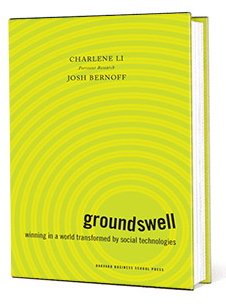
Lessons from the Groundswell: What Higher Ed can Learn from Social Technologies


A few weeks ago as I was about to get on an airplane from O’Hare airport to San Francisco, I realized I had no reading material. I promptly scurried to the nearest airport bookstore and found myself frantically searching the shelves for the right read. It had to be mentally stimulating, innovative, exploring a cutting edge idea and relevant to technology and teaching. As I panned the book covers trying to make my selection like a magician waving a wand over hat waiting for a magic bunny to pop out, I identified with a short story from Dan Pink’s Whole New Mind. He wrote of the need for business leaders to embrace creativity due to the society of abundance in which we live in America. He described wine connoisseurs standing in wine warehouse with hundreds of Merlots competing with each other on the shelves. Which one? Well, the one with the catchy cool label, of course!

Using a similar methodology, I found my book. The chartreuse cover got me, ahhhhh...that color that took me back to my passion for fluorescent clothes in the 1980s...come on, you remember the Cyndi Lauper, Duran Duran, and Boy George days. “Was this an attempt to reach out to the Gen-X market?,” I wondered … and the oh, so cool font that actually conveyed a message. The cover had me.


The book I chose is called “Groundswell” by Charlene Li and Josh Bernoff of Forrester Research, an IT and Marketing consulting group that partners with business leaders to harness the power of the swirling patterns and tornado-like trend of social technologies, among other projects.

Social technologies? Yes, this refers to MySpace and Facebook but, as Li and Bernoff explain, social technologies reach far beyond the giant social networking sites that young people find more appealing than television these days. Social technologies also include discussion forums and user reviews, like those great hotel reviews written by people just like you and I that tell us what those hotel rooms really look and smell like, as well as content creation sites like YouTube, Flickr and blogs.

The book is a fascinating read and the authors are clear about one message to business leaders, “If you want success, you can’t ignore the groundswell.” And like all fascinating and innovative ideas I come across, I can’t help but apply them to higher education. Social technologies, as Groundswell persuasively argues, have already transformed the way people in the US, Europe and parts of Asia are communicating but they’ve also reshaped the traditional business model. As the book explains, a company’s brand isn’t owned by a corporation, it is molded by its customers. Customers are sharing thoughts about your brand right now in the groundswell, whether you want to acknowledge this or not. You have to listen to the groundswell to identify your brand. What you learn may be in sync with your vision of your brand but you may discover that your customers don’t quite agree. Listening could be viewed as a risk, as you’re opening yourself up to the possibility of hearing some very negative reflections of your brand but, in this age of interconnectedness where information travels at the speed of light, not listening is much riskier to a business leader.

Li and Bernoff explain that businesses regularly spend tens to hundreds of thousands of dollars working with research marketing firms to conduct focus group studies and surveys that can take up to a year to develop and retrieve information about their customers thoughts and feelings about the company. However, social technologies as a research medium can reveal far more relevant information in a few weeks. The interesting point is regardless of whether or not a business listens to the groundswell, the current of messages and ideas will continue to swirl.

Ok, so how does this apply to higher ed? I see a tremendous amount of potential in the social technologies for recrafting pedagogy and enrollment trends in higher ed; however, I don’t see the same excitement and passion about listening to it as I detect in the private sector. Actually, I see many professors reacting to the "groundswell" as if it’s a pesky fly that keeps landing on their nose. They will do anything to just wave it away and hope it doesn’t really get in the way with their task. But can’t the groundswell tell us how we’re doing as educators? Can’t the groundswell assist us with understanding how we can meet the learning needs of our students? And how we can improve our student services?

The groundswell holds tremendous potential for higher education to improve what we do but it’s also risky. The groundswell completely undercuts the traditions of higher ed which situate the “professor” as the owner of information, at the center of the class, surrounded by students who absorb the information and are rewarded with a good grade for reciting it back. The groundswell subverts this model. The groundswell places the professor in the role of a facilitator who must be ready to adjust the flow of a learning unit or the mood of a dialogue. The groundswell requires listening, acknowledging the validity of students’ thoughts and feelings and it requires flexibility and risk-taking.

I think it was about three years ago when the groundswell first entered my teaching experiences. Now, we need to keep the notion of “tradition” in mind as we contemplate this example. I had a colleague of mine ask me, “Have you seen that new site called RateMyProfessor.com?” I looked at her eagerly and said timidly, “No.” She chuckled and said no more. I drove home frantically that night anxious to Google this new student generated rating system for professors. Part of me felt completely violated...what nerve these students have to “rate” me without my consent. The rest of me was so excited to ponder the effects of this new concept. I mean, when before have students had the power to highlight the positive and negative aspects of a professor’s class and share this information openly with the world? I began to envision the effects on enrollment patterns and a completely different notion of “accountability” outside of tenure. No, I’m not implying that tenure should, in any way, be affected by RateMyProfessor.com but what I do see happening is generation Y students “flocking” to the professors that have good ratings...yep, and that includes chili peppers (something I read as tied to our media driven culture in which “good” teachers are now expected to look “hot”….ugh). Wow, this is going to seriously rock some foundations.

RateMyProfessors.com is part of the groundswell. Higher ed students pay for their learning experiences and want instructors who have favorable student comments. I think what they really want is to have professors who they like. Is this really so awful? Of course, we need to take these so called "ratings" with a grain of salt. Like all opinions, they're just "opinions."

Freshman Irene Medina felt betrayed after relying upon RMP's info when she made her class selections. In a blog post, she recently wrote, "For one, students have different perspectives of a professor. We can’t all possibly have the same opinions about a teacher. That anonymous student loved his class but I completely hated it. Are the ones who love it the only students who know about that Web site?"

Medina continues to ponder about whether or not professors actually post their own "ratings" in an effort to inflate their popularity. Hmmmm. Regardless, professors should be reading and listening to the comments in RateMyProfessors. Yes, take them with a grain of salt. Assume some of those students who you rubbed the wrong way with a tough grade are using the site to retaliate. Heck sometimes I wonder if some of the comments are posted by cronies or the professors themselves. We'll never know. But we still need to be aware of the messages that are out there about our classes. If you're a professor and you find something inaccurate or disturbing, talk to your students about it. Let them know you read the site.

Listening, I mean consistently listening and responding to what one hears, is one step towards a major shift in higher ed pedagogy. It’s an indication of a shift from the tradition of a “sage on the stage” to a “guide on the side.” And to many professors, it’s scary. What if our students had the opportunity to engage in their learning experiences just as they can now engage in rating their professors? How would that transform learning? Some students may be more likely to share a problem with the class that would have otherwise gone undetected by the group. For example, if Jim’s professor wasn’t replying to his emails, he could share this information with the class and give other students an opportunity to chime in on the topic.

A professor I spoke with recently shared with me that he was nervous to adopt blogs in his class because he was concerned about whether or not the students would have anything positive to say about the class. Well, if we don’t take a risk and listen then we’ll never know.

I find that my students are appreciative when I try something new. I tell them, “We’re trying this out this semester for the first time. Here is why we’re using it and here is how I hope it will enhance your learning. If I’m wrong, you’ll have a chance to let me know at the end of the semester and I'm open to suggestions for adjusting our direction along the way.” Students respect an instructor’s interest in experimentation and exploring new ways of teaching concepts. When it doesn’t work, they tell you and ... guess what? You change what you’re doing and try something else. When it does work, it’s the most rewarding and energizing experience to get those tremendously supportive and enthusiastic comments from students. I call them “my golden nuggets.”

So, what if, instead of posting lectures in Blackboard for our online students and then having them respond to prompts in a discussion board, we used Blackboard as a springboard or a huddle where our students get the plan for the the current learning unit, review critical content items and then jump into a Ning group where they create their own social profile, make friends with other students in the class, exchange ideas or debate class related topics, share bookmarks to relevant websites, retrieve thought provoking movies from YouTube and, together, create a community in which learning is social rather than linear.

As teachers, we know our students don’t learn the same. We know learning is social. And the world is undergoing a social transformation. Martin Weller, Professor of Educational Technology at the Open University in the UK, recently wrote:

“Higher education faces a challenge. It may not know it yet, but it does. And the challenge is this – when learners have been accustomed to very facilitative, usable, personalisable and adaptive tools both for learning and socialising, why will they accept standardised, unintuitive, clumsy and out of date tools in formal education they are paying for? It won’t be a dramatic revolution (students accept lower physical accommodation standards when they leave home for university after all), but instead there will be a quiet migration. The monolithic LMSs will be deserted, digital tumbleweed blowing down their forums. Students will abandon these in favour of their tools, the back channel will grow and it will be constituted from content and communication technologies that don’t require a training course to understand and that come with a ready made community.”

Weller’s thoughts are compelling especially to a major LMS like Blackboard whose tools are not only clumsy but archaic and non-visual. And I must concur that higher education does face a significant challenge but it’s one that few professors or administrators have acknowledged as more than just a mere “fad.” Or, worse yet, I often hear professors react with frustration and annoyance at the thought of having to change the way we teach just because they are socializing differently. We have to get through this “us” and “them” thing. We are in this together.

But beyond the learning potential for social technologies and the groundswell of change they will evoke in higher ed, I’m also eager to consider the power of reaching out to our students through social technologies to understand their needs at an institutional level. What are the criteria for a high quality online college learning experience, from the students’ perspective? For years faculty have been trying new things in online classes and surveying our students to identify how successful the teaching experiments have been. Sloan-C is the best resources I’ve found for reviewing these terrific case studies..and they are consistently terrific…but couldn’t we or shouldn’t we, as higher ed professionals, begin to adapt Li and Bernoff’s business model for research to assist us with planning for the future success of our institutions and, ultimately, our nation? One in five higher ed students were enrolled at least one online class in 2007 and this number is growing. What would we learn about building quality online programs if we engaged our students in a dialogue about this topic and listened to what they have to say?