Showing posts with label chronicle of higher ed. Show all posts

Monday, February 22, 2010

Preparing Professors for 21st Century - not just a K12 issue


I read an article today in the Chronicle of Higher Ed today that told about U.S. education secretary, Arne Duncan's, concern about the need for teacher colleges to improve. His message was aimed at graduate schools around the nation that provide teacher preparation programs, indicating that they are outdated and need a refresh.

As I read this article, I clearly see that it's vague and makes no effort to identify how the programs need to be updated.  But it left me thinking about a comment that was left on the VoiceThread I shared with you all in a recent blog post.  I received a comment on the first slide of a VoiceThread I shared from Maryanne Bergos, who shared with us that she teaches a fully online class for pre-service teachers that introduces them to a variety of free web 2.0 tools that hold potential for teaching and learning (VoiceThread being one of them).  "Hmmm...what a great idea," I thought!  After hearing Maryanne's comment, I became quite enthused as I imagined an entire movement of exciting new curriculum lighting up around our country inspiring young, new educators about the possibilities that emerging web 2.0 tools (free web 2.0 tools) hold for them and their students.

Then, a couple days later, I read Duncan's article.  There's such a gap between these two feelings I have right now.  I'm not exactly sure where Maryanne is teaching but hopefully she'll come back and leave a comment and share more with us here and maybe some others will enlighten us about your own teaching program and how "current" they are.  What are your reactions to Duncan's message? If you are part of a teaching program or have graduated from one recently, do you feel it is in need of a refresh and, if so, in what way?  And then the next question would be, "If the program is current -- is the school you are teaching at outfitted with current technology and ready to support your 21st century teaching skills?" 

But today I want to take this question into our colleges and universities, suggested already by the humorous video that greeted you at the start of this blog post.  Teaching programs produce educators who generally enter our K-12 educational system.  But what about all of our professors in higher education who enter college classrooms with generally no understanding of instructional methods whatsoever?  This is not a personal criticism of a college professor, although I could bet my laptop there will be many who will read this and take it that way.  This is an objective criticism of the training and hiring process in hiring education from an individual who has experienced it firsthand.  We have fostered a system of higher education that welcomes subject matter experts into our college classrooms who rarely have any understanding of pedagogy beyond the skills they have observed in their own "training" throughout their undergraduate and graduate careers which, I would bet, are primarily still comprised of lectures.  I won't go into my "lecture" rant here.

So, as I reflect on Duncan's call to refresh teaching programs throughout our nation, I beg us to widen this circle of inquiry and reflection and ask, "How would the quality of our college teaching change if a teacher training course was required at the master's level for every discipline?"  I'm referring to a history student earning a master's degree, a math student earning a master's degree, a chemistry student earning a master's degree, etc.

I leave you with one final story that I think about probably way too much.  In 1999 I graduated with my master's degree in art history.  At the time, I knew I wanted to teach at the community college level that that's just what I went on to do.  However, my roommate, we'll call her Allie, chose to continue on for PhD.  She was admitted to an excellent program in New York.  Nine arduous years later she completed that PhD degree.  She called me to enthusiastically share that she had obtained a sabbatical replacement position at a college in New York, a very competitive position that she was very excited about.  I rejoiced in her excitement.  Wow, she worked hard for this!

However, what dismayed her and left her chilled to the bone was the fact that the department that she'd be teaching in had its classrooms equipped completely with digital projectors and she was expected to build her lessons with digital images, although the college was not providing any for her.  In her years of training as a student teaching assistant, Allie had only taught with color slides.  The classrooms at this college had no slide projectors and she had none of her own.  She had always relied upon the collection of her graduate institution.  But now she was on her own.

She was an analogue art history professor stranded in a digital art history world.  Allie had no clue how to locate digital images or how to prepare digital presentations.  What she had was over $120,000 in debt and a PhD degree that qualified her to teach.  But was she prepared to teach?

As I think about Allie's situation, I can only imagine the realities of new grads who, in this dire job market, land a job (does that still happen?) and find themselves teaching online.  Heck, I imagine veteran college instructors making this transition too and feel the same way.  Imagine that cold, hard reality.  Sure, if you're a full-time faculty member, they likely have access to a faculty development center, and hopefully it has online training fully integrated (but I know for a fact many do not).  In fact, We know from the recent APLU-Sloan survey (that did not include community colleges in the sample) that 4-year faculty are dissatisfied with the support they receive for teaching online and support includes online pedagogy training and instructional design assistance.  But imagine how this dissatisfaction grows if you are a part-time instructor

According to the 2009 Community College Center for Student Engagement survey, 67% of community college faculty are part-time instructors.  That's an enormous percentage of the faculty teaching within the two-year institutions across our country.  We also know from the annual Sloan-C surveys that that the rate at which students at two-year colleges take online classes is about double that as in four-year institutions. More than one-half of all students enrolled in two-year institutions are taking one online course (this data was recently confirmed for me in an email exchange with Jeff Seaman from Babson Research, although the data was not included in this year's Sloan survey report, Learning on Demand).  Hmm.  Seems to me that there's a pretty significant argument here for putting out a call for updating the teaching skills of our college instructors.

The question becomes...who is the advocate for this lofty call within higher education?  How do we, as a nation, improve the teaching preparation of our college professors for the 21st century to include face-to-face, hybrid and online instruction?

Wednesday, February 17, 2010

Come Learn with Me! Building Online Community with Emerging Technologies starts March 1

Create your own video slideshow at animoto.com.

Cultivating an effective community of learners is an essential element of success in online education. This is not earth shattering news, as community has been a foundational topic of online learning research for years (Palloff and Pratt, 2007; Clark and Mayer, 2003; Richardson and Swan, 2003; Ko and Rossen, 2008; Graham et al, 2001). However, what is new and critical to the professional development of online instructors, instructional designers and other faculty or program support related positions (and arguably administrators providing the strategic direction of online programs), is the new suite of web based tools that have recently emerged that offer community building powerhouse potential.

On March 1, I will begin teaching a 4-week online class for @One, an organization that is able to offer very low cost professional development training for online educators as it is funded through a grant from the California community college Chancellor's office. The class is titled "Building Online Community with Emerging Technologies" and it is an overview of tips and strategies for cultivating community online, couched within hands-on experience with web-based collaborative technologies that demonstrate potential for bringing students together, sharing ideas, crafting participating learning environments and knitting the foundations of community. Specifically, you'll gain hands-on experience working with your peers in Ning, VoiceThread and WetPaint (a web-based wiki tool). I focus on free to low cost web 2.0 tools that educators can turn around and integrate into their classes, regardless of whether or not their institutions subscribe to them (this one reason why web 2.0 is so empowering for educators -- and you'll learn that you don't need to be a techie!)

@One classes are something to be taken advantage of (!11). The 4-week class is only $50 to faculty and staff of California state supported schools, colleges, or universities (that is an amazing price!!). The courses cost $100 for educators outside the California state systems. Share the word!! Register before Wed, February 28th. Class begins on March 1st. For more information, please visit www.onefortraining.org

Tuesday, December 8, 2009

How are Californians Feeling about Higher Ed?


I just learned via the @One blog that the Public Policy Institute of California released new survey that shares concerns and opinions of Californians about the status of higher education in their "golden state." Below you will find my excerpts from the report including some brief overview information and a few highlights of the findings. I strongly encourage you to download the full report (in PDF) to review its entirety on your own.

How do your thoughts compare? Do you think Californians have gauged the severity of this issue realistically? Could a bond measure solve this issue? Will the hallmarks of higher education survive the deep-seated innovation that would be necessary to rethink and retool this system for 21st century success? Are we seeing the higher education "problem" as a "21st century problem" rather than just a "deficit" problem? What do you think?

The PPIC Statewide Survey provides policymakers, the media, and the general public with objective, advocacy-free information on the perceptions, opinions, and public policy preferences of California residents.

Higher education is guided by a 1960 master plan that calls for making a college education available to every qualified California high school graduate. Currently, about 3.6 million students use publicly funded higher education, according to data from the three higher education systems, the California Community College (CCC), California State University (CSU), and University of California (UC). Higher education faces immediate challenges—including significant state budget cuts, the rising costs of a college education, and continued weakness in the state and national economies. It also faces long-term challenges: projections of increased need for college-educated workers in the state and rapid population growth.

The report presents the responses of 2,502 California adult residents, including 1,488 likely voters and 973 parents of children 18 or younger.

Californians place more importance on a college education than do adults nationwide.

The majority of Californians place a very high or high priority on spending for public higher education. Given this priority, what are Californians ready to do to offset state spending cuts?

68% are unwilling to increase student fees.

56% are unwilling to pay higher taxes. (How does this breakdown along party lines: 56% of Democrats are willing to pay higher taxes, 58% of Independents are willing and only 26% of Republicans are willing.)

53% would support a higher education construction bond measure on the 2010 bond ballot.

50% believe that major changes are needed in higher education.

59% are very concerned and 29% are somewhat concerned about reducing the number of students admitted as a way to offset budget cuts.

The same, 59% are very concerned and 29% are somewhat concerned about cuts in course offerings.

48% are very concerned and 32% are somewhat concerned about reductions in faculty and staff pay.

89% of parents with children 18 years or younger hope their child or children will receive a bachelor's or graduate degree. Latino parents are more worried (67%) than white parents (38%) about being able to afford to send their children to college.

Thursday, November 26, 2009

Here is your lecture -- read or listen, it's your choice

The Chronicle of Higher Ed featured an article this week about CSU Dominguez Hills that showcases an example of an institution embracing assistive technologies like kurzweil, which translates students' reading material into audio content for a listening option. However, instead of utilizing kurzweil specifically for students with disabilities, as has been the tradition in education, we are now beginning to see the benefits of offering such services to all students as a learning resource.

For years, I've built my own online courses with the option for my students to read or listen to my lectures. Imagine the difference here -- while kurzweil is terrific, as it converts a text-based article into a voice, it's a mechanical voice. What if students were given the option to read a lecture or an article in a professor's voice with her or his passion and inflection in full force? How different would that be for her learning experience? Aren't these the questions we should be posing here? Wouldn't this be enriching our students' learning and be honing in on issues of retention, success and increased learning? I think so.

When teaching online in the fall of 2008, I surveyed two of my online classes. 87 students responded which was an 87% response rate. Here are a few interesting things I learned. I was anxious to know whether or not my students actually used the audio option for the lectures -- I realize in college they were used to reading and, perhaps, they'd simply revert to what they were accustomed to. I was also teaching at an underfunded community college and had absolutely no instructional support so 100% of the podcast development was on my own shoulders (an issue that should not fall through the cracks here, especially since the majority of online enrollments in the US are blossoming in our community college districts per the Sloan-C annual surveys).

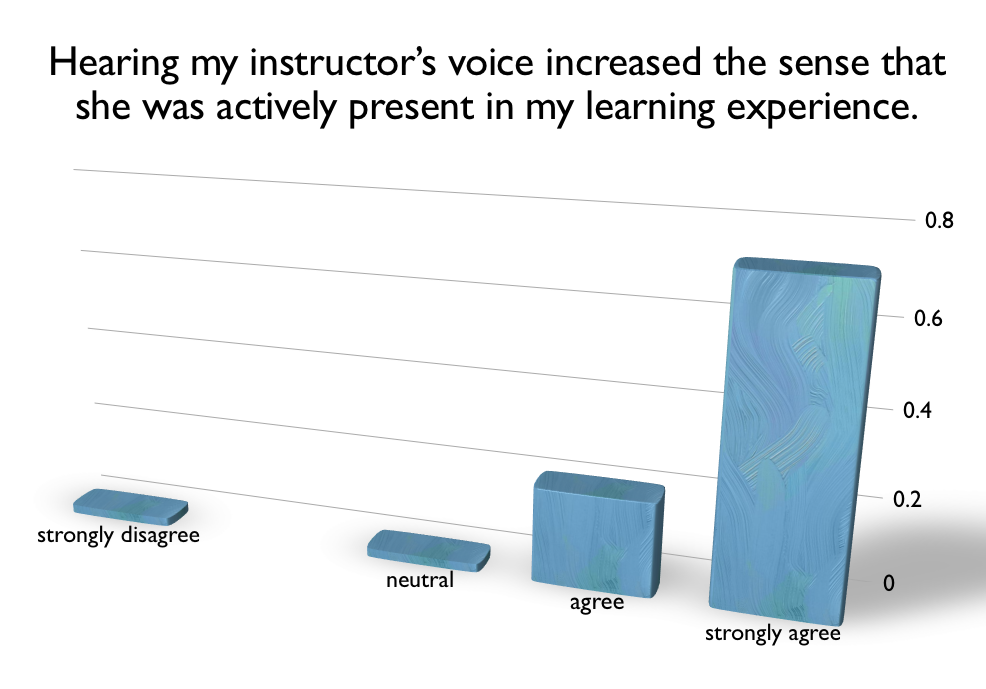
I was also curious to learn whether or not hearing my voice increased my students' sense that I was more actively present in their learning experience at a distance. Of course, research demonstrates that that the learning in isolation significantly increases challenges for students to succeed and when these teaching at a community college, one needs to be especially aware of the diverse population of students one is serving at a distance (english as a second language, learning disabilities, etc.). In response to this question, here is what I learned:


When I asked students which of the formats they accessed -- remember, they always had a choice and the content in the audio and text lectures was exactly the same. Actually, I used the text file as my transcript for the audio file. Here is what I learned:


This image reveals that 34% of students elected to read the PDF, while 21% listened to the podcast version of the lectures and 45% of students chose to do both. I honestly hadn't even thought to myself that students would choose to listen and read the lectures but I had begun to notice these comments flow in to me from students in the form of emails quickly after I begun to offer the lectures in both formats and it floored me. When I deployed this survey to my students, this was the result that stunned me more than anything else. And I surveyed another class of students the next semester and the results were actually very similar. When I asked students why they listened to and read the lectures, they simply responded "because it helps me learn." Wow. Imagine that. And here we are, struggling, endlessly, pouring billions of dollars into our educational system trying to figure out what we need to do to help our students learn. Maybe this isn't so hard.

The ability to listen to the podcast over and over and hear my voice stress particular elements of the content was important to my students -- this is an element the text version of a lecture won't convey to an online student and it's something kurzweil won't offer to a student either. The professor needs to be present in a students' learning to be able to stress certain key elements of content and, of course, convey passion. A mechanical voice will never be able to do that.

Finally, when my students were asked "Having the ability to read or listen to the lecture increases my ability to achieve the learning objectives," 96% of my students either strongly agreed or agreed.

Perhaps we should consider investing some funding in supporting a personal approach to online teaching within higher education? Let's break out those microphones, folks, and give our students a choice in how they learn!

This seems like such a basic concept to me and one we should have been implementing into learning (face-to-face and online) long ago. Audacity is a free recording software and microphones cost under $30. This isn't an expensive project. Training is simple. What's the hold up? Let's do this thing.

Related Resources:
Teaching Without Walls-Educause Learning Initiative Webinar

Saturday, November 7, 2009

The Shifting Landscape: Enrollments and Quality Learning in Higher Ed

This post is in response to a comment left on my last post, "Online Learning: Pay it Forward" by Barry. Barry, I found your comment intriguing in many ways and it touched on a lot of ideas that have been on my mind lately about higher ed: competition in higher ed enrollments, the need for quality learning across the board in higher ed, the new standards for "face to face learning" that I am sensing from our YouTube generation of students.

In Barry's comment he stresses a concern that higher ed institutions are at risk of losing enrollments to any well funded institution who can craft staff that includes "the best" online educators which, I assume, means subject matter experts with a mastery in online pedagogy, supported with a team of creative individuals to assist with cultivating dynamic, engaging learning experiences anchored by solid learning objectives (the core of an effective online learning experience). Well, Barry -- you're spot on. And it's happening. Nancy Martinis recently shared this article, College for $99 a Month, from Washington Monthly with me. It was alarming to me, so much that I find it rather difficul to summarize in this blog post. It describes your scenario (and then some) but the model that is being sold to students, and ravenously devoured might I add, is void of the passionate online professor. Think back to your undergraduate college experience. I bet every one of you can think of at least one passionate professor -- in some discipline, even if it wasn't your major -- that inspired you, motivated you to see the world differently. That's what our students risk losing with this new model, in my opinion.

Students are leaving traditional colleges and universities in hoards as they're being confronted with closed doors due to budget cuts, as well as outdated, inconvenient modes of instruction that don't meet their needs. Our students are only trying to get the degree they need so they can achieve their professional or personal goals. It's our job to ensure the degrees they get result in quality learning.

Before the shift from online non-profit universities to online profit universities/corporations began, we saw a significant decrease in face-to-face enrollments across the nation within institutions. If your college/university has a significant online program, 5-7 year date will likely demonstrate a decrease in face-to-face enrollment and a simultaneous increase in online enrollment -- check it out yourself. But...be warned that you'll have to be quite scrupulous as you analyze that data because often colleges and universities seem to embed online data with their face-to-face enrollment data, clouding the fact that their face-to-face enrollments have tanked and their online enrollments have soared.

So, let's focus on this interesting shift for a moment. Why are students leaving face-to-face classes for online classes -- either within their own institution or elsewhere? The article above poses many reasons but there is one that isn't addressed that I'd like to work through a little.

I truly believe that there are many young students today who prefer to learn in face-to-face environments but they find their classroom experiences passive and painfully irrelevant. It seems that the "YouTube Generation" may be establishing different standards for their "face-to-face" time than previous generations. And, when you think about the type of content they access through streaming media, it makes sense.

Why, for example, is a twenty year old college student going to be compelled and motivated to show up, in-person, for an 80-minute session of sitting passively, lost in a group of forty other students, listening to a professor talk about a topic? THAT is content that should streamed for students. Take those lectures and put them online. Have students access them before coming into the classroom. Reactivate the classroom experience for our students, make it engaging, make it dynamic, make it relevant and meaningful. Give them a reason to be there other than "because I said you need to be here." If you haven't watched Jose Bowen's 4-minute "Teach Naked" video yet -- watch it. And don't miss the last minute, as it is very relevant to this discussion.


Bowen's Teach Naked approach, which stresses the importance of taking the technology out of the classroom, is similar to the course design strategy I employed in my Teaching Without Walls experiment that I shared with the Educause Learning Initiative in September. You are welcome to listen to the 20-minute interview I had with a few of my students the last week of the semester. Or download the PowerPoint here to review the student survey results. We need to think carefully about design active learning experiences in the classroom and online so our students view all levels of American higher education as relevant and important.

For those of you interested in following the dialogue about "quality learning" in higher ed, I encourage a thorough reading of Jamie P. Merisotis' recent presentation at Claremont University titled "It's the Learning Stupid," in which he eloquently identifies higher ed's lack of delivering quality educational experiences for students centered around assessing clear learning outcomes. You may be interested in knowing that Merisotis also just delivered a keynote presentation in San Francisco to community college trustees, as well.

Our discussion of innovation in learning needs to stay anchored in quality learning. That is essential and, to me, I believe public higher education has an extreme opportunity to achieve leaps and bounds now over corporate online learning "machines" that are turning out online classes devoid of passion and teaching presence. Students come to college to learn from passionate educators -- that's no different in an online class.

But this will never happen if colleges view their license renewal of an LMS as their only necessary commitment to supporting an online learning program. An LMS does nothing to ensure quality learning and it does nothing to foster innovation. (Barry, this was another great point of your comment.)

An LMS (Blackboard, Moodle, Desire 2 Learn, etc.) is merely a shell for organizing, structuring and managing course content and communicating confidential grade information to students. I realize there are slight innovations shifting in some LMSs but an institution can't merely pay loads of money for faculty to have access to an LMS and consider a program built. Faculty need pedagogy training and much more beyond that.

When I teach online I consider Blackboard the "train station" for my students. They come into it each week to get their itinerary for their learning "journey" and then they go out to engage in web-based, collaborative web 2.0 activities (VoiceThread, Ning, WetPaint) and more customizable content (iTunes U) to learn. The LMS is only one tool in a very, very rich toolkit needed to teach successfully online. That big price tag can't be viewed as, "ok, that's all we need to spend on educational technology for the year." If it is, you'll never foster innovation.

In fact, I still get emails from previous students who write to me about their "flat" learning experiences "back inside" Blackboard using the discussion boards. It seems that once students are pulled into collaborative, peer-based, visual learning activities, it's tough to go back to text-based threaded discussions and be engaged.

Thanks for your comment. We're in for an interesting ride. The landscape is shifting all around us. It truly is an opportunity to make great changes.

Hopefully,
Michelle

Friday, October 30, 2009

Online Learning: pay it forward

Things are a mess in higher education now and we need new ideas to help us move forward. In my last blog post, I reflected on the loss of California's proud history of higher education which includes magical stories of free community college degrees that opened gateways and fulfilled dreams of socially disadvantaged individuals who, otherwise, would likely have never completed a college education. I received a few comments from that post and several heartfelt emails from individuals who had earned degrees through this "free college" system. The emails were filled with tremendous heartbreak over the recent budget cuts to California's higher education system and, more specifically, how those cuts are impacting students' access to learning.

Of course, we all realize something has to change. First, public education in California, and across our nation, needs more funding in order to ensure our students are provided with access to affordable college education. However, we need more than money. We need new approaches to education; new ways of thinking about connecting our students to learning experiences.

This week was the 15th Annual Sloan-C International Conference on Online Learning. Two years ago, I was awarded with the Sloan-C Excellence Award in Online Teaching, which will remain a highlight of my career forever. Sloan-C has been a leader in the field of advocating for quality online learning since before most educators had even considered the notion of "distance learning." This was the first year since receiving my award that I did not attend the conference. Despite being invited to participate in a prestigious panel discussion titled "Ask The Experts," I was not granted funding to travel to Orlando due to the California budget cuts. Therefore, I was not in attendance this year. That was tough for me, as I feel being part of the international dialogue about online learning is an important part of growth as an educator and an advocate for faculty who teach online.

While I wasn't there in person, I did read an article today in the Chronicle of Higher Ed that featured some thoughts about the conference. Despite the drastic travel restrictions, conference attendance increased from 1,190 to 1,435 people (in person). Frank Mayadas, long time Sloan Program Director, addressed the crowd with a call to action -- a call to meet the demand to retrain Americans who have been laid off and are now in a state of transition seeking new skills for a career change. Online learning opens new avenues of opportunities to students who may be unable to attend a physical class due to other circumstances (which could include a host of topics from child care challenges, work schedules, psychological disorders, physical disabilities, etc.). Online learning is in demand. We know that. It's not a shock. Last year's Sloan-C report, Staying the Course, revealed that 3.94 students in higher ed were enrolled in at least one online class in 2007. That's about one in four students. I'm waiting for a new report to see the new numbers but I'd anticipate these numbers will continue to rise.

What's buried in these numbers is the fact that more than 50% of these online students are enrolled at community colleges. I can attest, from my informal research of observing and listening and conversing the online conferences I've attended across the nation in the past few years, that the large majority of those who attend professional development conferences focused on online learning come from four year universities. Also, having been employed as a full-time faculty member at a California community college for seven years, I can all share that I do not ever recall any community college in California that I came into contact with that had an instructional design team on staff or even a single instructional designer -- thoughts anybody? I'd love to hear from some of you about this topic.

If you are employed at a community college or a university, do you have an instructional design TEAM to support faculty with developing their online courses? What about multimedia support specialists, accessibility specialists, graphic designers, and learning management system staff? What's the faculty support structure like at your community college or university? Let's compare.

Developing online classes is a lot of work. This is not a myth. 85% of faculty with online course development experience agreed that it takes "somewhat more" or "a lot more" effort to develop an online course. The recent APLU survey provides an indepth look at faculty attitudes and opinions about online learning. Most important is their blatant disappointment in their campus support structure (including support for course development, delivery, students, and more). And we need our instructors to maintain a high level of teaching presence in a class for online learning to be high quality. This is where I get concerned.

We have an opportunity right now to put our heads together and support faculty, foster innovation and cultivate communities of course development and shared online content resources that result in online classes with high-touch teaching presence, rather than dull, dry, disconnected content deployed to students through a computer screen -- that's not a quality online course.

Back to Sloan...Frank Mayadas, Program Director for Sloan, has stressed the need for offering more online classes to fulfill the needs of training our workforce. Excellent point. He has also stepped up and encouraged the Obama administration to fund free online courses for community colleges. Perhaps, this is an opportunity to move us back closer to the 1960s free community college education in the California golden state.

This is sounding intriguing, isn't it!?

But the excellence of this plan hinges on whether or not our faculty, the subject matter experts and the human souls that foster and inspire learning, are a core element of the online learning experience. And whether or not instructors are teaching courses that are designed to actively engage students in creative, active learning environments with teacher mentoring and facilitation. It is not acceptable to think of "teaching presence" as a "bottle neck" towards achieving our goal of delivering access to online learning to our student population. Instead, we need to focus on new methods of organizing and funding support for our faculty as an integral element of online programs, rather than a secondary or tertiary afterthought that faculty must fight for.

Frank Mayadas said, "If we’re going to have instructor-led courses, you better get your faculty very enthusiastic, beating on the doors, saying, ‘Give me help. I want to go online.’ And I don’t think we’ve done that." I fully agree. It's time our faculty become empowered to be advocates for the support needed to deliver a quality online learning experience to their students.

And, finally, I also believe it's time higher education begins to foster the value of innovation. How will faculty be encouraged and motivated to try something new, something different -- to take a risk -- when academia is so focused on success? Failure is part of growth and success in a culture of innovation. And if we're modeling innovation and risk taking in our teaching methods but trying new activities and pedagogies, then we're cultivating strong, creative thinkers for the 21st century.

Online learning is our golden opportunity but it's up to all of us to advocate for quality online learning so we pay it forward, rather than open access to dead, irrelevant learning experiences. I hope we play this one right.