Showing posts with label audio. Show all posts

Tuesday, October 29, 2013

The Center: Supersizing the Online Learning Sweetspot!

CC-BY-NC Jim Bumgardner

The Center: Increasing Innovation in California's Community Colleges   

brought to you by @ONE

Google+ Community:  gplus.to/TheCenter
Twitter:  @Center_Ed

As Community Coordinator for The Center, I have the awesome job of harnessing the power of Google+ and Twitter to increase collaboration, sharing, and innovation throughout California's 112 community colleges (the CCC system). How cool is that?

Two community interests are showcased each month as a combined dialogue that starts with a Google+ Hangouts on Air, extends into a Center Challenge, and wraps up with a Twitter chat.  The Hangouts on Air are live video conversations in which I engage in casual conversations with CCC educators about innovative practices pertaining to the topic. The Hangouts stream live to the web and viewers may submit questions via Twitter using the hashtag #CCCLEARN.

The week after a Hangout (every other Thursday at 3pm PT), a Twitter chat is held, giving community members an opportunity to engage in an interactive exchange of sharing (in addition to the broader public who is welcome to join in), discussion and Q&A. The two events are bridged with a Center Challenge which is like a call to action to encourage individuals to share deeper reflections, ideas, or strategies related to each topic through blogging, Tweeting, and the Google+ community.  The Center leverages the hashtag #CCCLEARN.

Supersize the Online Learning Sweetspot: Hangout on Air

Here is the 30-minute video archive of the Hangout on Air, 
"Supersize the Online Learning Sweetspot."


Last week, I was joined in a Hangout by +Katie Palacios (@katiepala) an instructional designer from the San Diego Community College District (SDCCD), and +Samantha Hurst (@sammhurst), an anthropology instructor also from SDCCD.  Katie shared a conceptual framework of her own, which she describes is an effort to encourage online instructors to, "Supersize the Sweetspot of Online Learning."  In her model, she explains the importance of embracing the full potential of active learning when designing and facilitating an online class and stresses that most new online instructors gloss over the need to consciously build in active learning, because these types of learner engagement opportunities often occur spontaneously in face-to-face teaching (think "socratic teaching" style).  Therefore, Katie proposes a model to "supersize this sweetspot" which involves "mushing" content, interaction, and assessment together into a fabulously, messy learning experience (picture making a peanut butter and jelly sandwich). 

After Katie's brief, engaging, and information presentation, Samm joins in to share a teaching innovation of her own that was inspired by Katie's supportive instructional design efforts.  She shares with us how she is using Video Everywhere, a building block for Blackboard that enables students and instructors to post communications using a webcam (videos are recorded to YouTube, posted as Unlisted, and then they appear in Blackboard where students and the instructor may view them).  Samm has her anthropology students share video blog posts to describe an experience using non-verbal communication (body gestures, for example). Fascinating! In the Hangout archive, you have the opportunity to see two examples of fantastic videos shared by Samm's students (who provided permission to allow us all to view them -- thank you!). 

Supersize the Online Learning Sweetspot: Twitter Chat

After you view the video, if you'd like to continue the conversation about Supersizing the Sweetspot of Online Learning, join me and other CCC educators for a #CCCLEARN Twitter chat this Thursday, October 31st at 3pm PDT!


Monday, October 29, 2012

Archive: Learning Out Loud-Is It the Missing Link in Online Classes?


Webinar: Learning Out Loud from VoiceThread on Vimeo


Above is the archive of a webinar I recently presented for VoiceThread.  In the webinar I shared results of a semester-long teaching experiment that resulted in increasing the percentage of voluntary student voice or video comments from 25% to 75%.  I also share student feedback results that demonstrate how learning out loud in an online class improved the students' perception of how well they understood of the material, improved their verbal skills, kept them motivated, and made them feel more connected to their peers and instructor.

View a list of all VoiceThread webinar archives here.

Wednesday, February 29, 2012

Are Online Students Hiding Behind Text?

Today, texting is the preferred communication method for most young people. It is used to get immediate answers to questions, find out what friends are up to, send grocery lists to oneself, reply to voicemails, and even end relationships.  I've seen many educators express concerns about how texting is fragmenting writing, grammar, and spelling skills but I have another question that I'm probing.  Are online classes allowing our students to hide behind text?

Despite the prevalence of free to low cost, easy-to-use, web-based multimedia tools (which are commonly associated with the web 2.0 era), most online college classes only require students to participate with text based communications -- discussion forums and blogs.  The 2011 Sloan-C report, Going the Distance, reminds us all how quickly online learning is becoming part of the mainstream college experience. In 2011, 31% of all college students in the United States were enrolled in at least one online class.  After nearly a decade of solid growth, we now have populations of adults who earned their entire undergraduate and even graduate degrees online.  What I'd like to know is how many of those students were expected to consistently demonstrate the ability to present, inquire, analyze, summarize, and argue in the spoken word?  I realize there are undergraduate requirements for speech that integrate these outcomes but my point here is that speaking should be a skill that is integrated across the curriculum, much like writing is.

For more than four years, I've used VoiceThread as a required part of my online classes.  I treasure VoiceThread because it enhances the tools included in the two course management systems I teach with.  It provides a visual, participatory conversation space and invites my students to leave comments in text, voice or video.  Each semester, until now, I have always allowed my students the freedom to choose which commenting method they want to use.  And each semester, I sit back and watch as most of them elect to use text.

I  regularly have a small group of students who step up and embrace the voice comments and a few who use video.  I have relished giving students the option to use voice or video because I have seen it yield success for students with cognitive disorders who are challenged with writing everything.  I also frequently have some students who genuinely love to share in voice -- but the point here is that most students don't.  When I've surveyed students in the past about why they didn't use voice or video, I commonly receive comments about "feeling intimidated," or concerns that they would "sound stupid." I realize my job is to ameliorate these hesitations and create a safe, trustworthy environment for students -- and that is precisely part of my revised approach this semester.

My question to you, as an educator, is "Should all online students consistently be expected to participate using voice or video?"  And if not, why?  What have we to lose?  Sharing ideas, engaging in large and small group discussions, and doing presentations are all regular components of face-to-face learning and I'd imagine the thought of removing all of these verbal activities from offline college classes would rile up some concerns.  So, why is it that we aren't focusing more on the integration of voice into a students' online learning experience?

So, in response to these questions, this semester I have embarked on a little experiment.  I don't have all the results to share because we're only in week six of the semester but I've seem some really significant changes in my students' use of voice commenting.  Most noteworthy is the percentage of students who are voluntarily leaving voice or video comments.  Last semester, in the class's third VoiceThread activity 25% of my students used voice or video to leave their comments.  This semester, in the third VoiceThread activity, 75% of them voluntarily commented in voice or video.  How did that happen?

Here are the changes I made this semester to increase the percentage of students who voluntarily comment in voice or video: 
  • ONE:  In my syllabus, I clearly indicated that voice or video comments would be required in some of the VoiceThreads.  I also explained what VoiceThread is and how it has improved the learning of past students.  Finally, I made it clear that the way we would be using VoiceThread was fully secure and only students enrolled in our class would have access to the students' contributions.  This was stressed to ensure students felt safe and didn't perceive VoiceThread to be a public tool, like many of the popular web-based tools students use today.
  • TWO: I surveyed students in week one (using Google Docs's Form option).  I had them identify which of the following methods they would use to leave their voice or video comments.  Below, I am sharing the percentage of students that responded to each method.
    • I will use a microphone with my computer to leave voice comments.  36%
    • I will use a webcam on my computer to leave video comments. 29%
    • I have an iPhone, iPad, or iPod Touch and will use the free VoiceThread mobile app to leave voice or video comments.  29%
    • I will use my phone to leave voice comments (if you check here, I will contact you and set you up with free phone commenting minutes).  7% 
      • You'll notice that the questions above do not provide the option to say, "I don't have the necessary technology."  Also, in Fall 2011, VoiceThread's release of their free mobile app, tremendously expanded access to voice and video commenting for college students -- a population with a soaring rate of smartphone adoption.  Next fall 2012 when they release their Android version, this will increase further.
      • Additionally, VoiceThread accounts above PRO have the option to include a bucket of phone commenting minutes that can be distributed to users who need them.  This allowed me to feel confident in my efforts to require voice comments, as nobody is excluded. I was able to easily reach out to the two students who required this option and get them set up quickly with free phone commenting minutes.
  • THREE:  I used a non-threatening, fun activity for our first use of VoiceThread.  Click here to view the activity (this is a sample copy without student comments).  Last semester, the first use of VoiceThread was a formative assessment of a long, rather complex essay students read.  And while mistakes were ok (again, it was a formative assessment), it was more nerve racking for students to hear their voice and be unsure of what they were saying.   I wanted them to proceed with confidence and embrace the sound of each others' voices, as well as their own.
  • FOUR: I required students to comment in voice or video in the first VoiceThread.  This was my attempt at 1) demonstrating to them that they could do it so they'd have confidence in their ability and 2) putting everyone on equal footing so they would all be expected to challenge themselves which, I realized, was going to make some students feel vulnerable.
  • FIVE:  After the third week of VoiceThread, I surveyed students to give them a chance to share with me how it was going and to understand their experiences using VoiceThread.  From this survey, I learned that:
    • 91% of students described their experience with VoiceThread as "Awesome" or "Good."
    • 95% of students agreed that, so far,  VoiceThread had added value to their online learning experience.
    • 71% said they prefer to comment in voice or video rather than text.
    • Most students also described their experience creating their VoiceThread account and joining their class group as easy.
Again, the qualitative analysis of their experiences commenting in voice and video will be conducted later.  From my perspective, I feel strongly that the use of student audio commenting in online classes is important for college students because it fosters verbal communication skills that the proliferation of mobile technologies is changing.  I don't want this to sound like a skeptical rant on mobile technologies though, as I would argue they hold an array of possibilities for making college learning more collaborative and participatory -- in the classroom, online, and via location-based learning treks.

I know that my students relish the opportunity to hear and see me in my comments and many remark to me that they rarely get such personalized feedback in their face-to-face classes.  And I relish hearing and seeing them.  Hearing their voices allows me to sense their confusion, their confidence, their passion, their concern, their frustration, and their joy -- which, to me, allows me to respond appropriately and be a much more effective online instructor.

What are the major obstacles that you identify for integrating voice-based participation into online classes?  And what suggestions do you have for improving these roadblocks?


Thursday, November 26, 2009

Here is your lecture -- read or listen, it's your choice

The Chronicle of Higher Ed featured an article this week about CSU Dominguez Hills that showcases an example of an institution embracing assistive technologies like kurzweil, which translates students' reading material into audio content for a listening option. However, instead of utilizing kurzweil specifically for students with disabilities, as has been the tradition in education, we are now beginning to see the benefits of offering such services to all students as a learning resource.

For years, I've built my own online courses with the option for my students to read or listen to my lectures. Imagine the difference here -- while kurzweil is terrific, as it converts a text-based article into a voice, it's a mechanical voice. What if students were given the option to read a lecture or an article in a professor's voice with her or his passion and inflection in full force? How different would that be for her learning experience? Aren't these the questions we should be posing here? Wouldn't this be enriching our students' learning and be honing in on issues of retention, success and increased learning? I think so.

When teaching online in the fall of 2008, I surveyed two of my online classes. 87 students responded which was an 87% response rate. Here are a few interesting things I learned. I was anxious to know whether or not my students actually used the audio option for the lectures -- I realize in college they were used to reading and, perhaps, they'd simply revert to what they were accustomed to. I was also teaching at an underfunded community college and had absolutely no instructional support so 100% of the podcast development was on my own shoulders (an issue that should not fall through the cracks here, especially since the majority of online enrollments in the US are blossoming in our community college districts per the Sloan-C annual surveys).

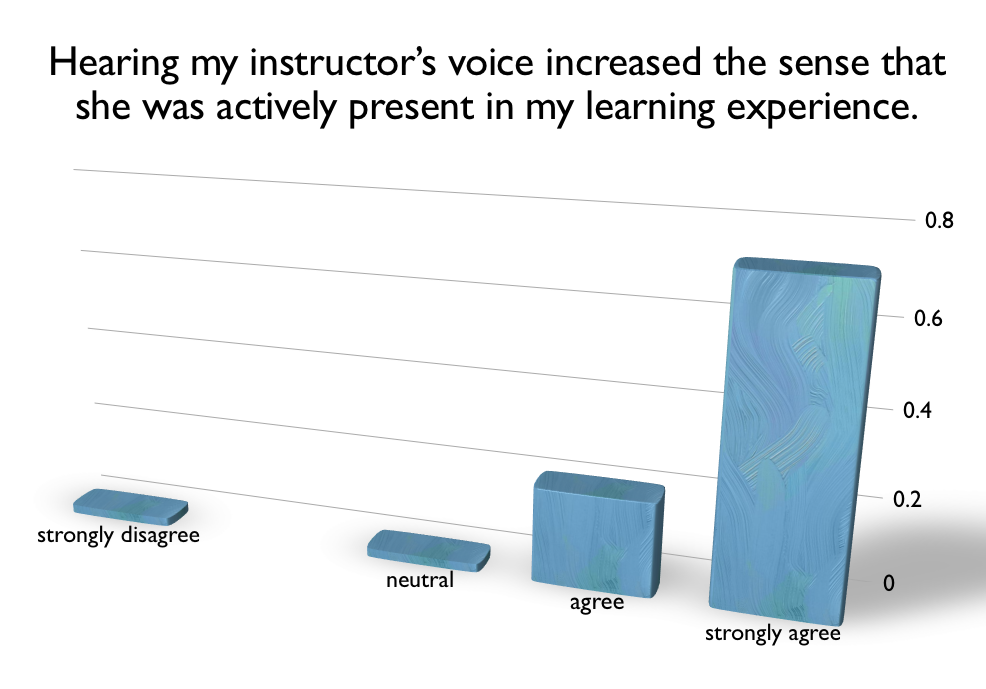
I was also curious to learn whether or not hearing my voice increased my students' sense that I was more actively present in their learning experience at a distance. Of course, research demonstrates that that the learning in isolation significantly increases challenges for students to succeed and when these teaching at a community college, one needs to be especially aware of the diverse population of students one is serving at a distance (english as a second language, learning disabilities, etc.). In response to this question, here is what I learned:


When I asked students which of the formats they accessed -- remember, they always had a choice and the content in the audio and text lectures was exactly the same. Actually, I used the text file as my transcript for the audio file. Here is what I learned:


This image reveals that 34% of students elected to read the PDF, while 21% listened to the podcast version of the lectures and 45% of students chose to do both. I honestly hadn't even thought to myself that students would choose to listen and read the lectures but I had begun to notice these comments flow in to me from students in the form of emails quickly after I begun to offer the lectures in both formats and it floored me. When I deployed this survey to my students, this was the result that stunned me more than anything else. And I surveyed another class of students the next semester and the results were actually very similar. When I asked students why they listened to and read the lectures, they simply responded "because it helps me learn." Wow. Imagine that. And here we are, struggling, endlessly, pouring billions of dollars into our educational system trying to figure out what we need to do to help our students learn. Maybe this isn't so hard.

The ability to listen to the podcast over and over and hear my voice stress particular elements of the content was important to my students -- this is an element the text version of a lecture won't convey to an online student and it's something kurzweil won't offer to a student either. The professor needs to be present in a students' learning to be able to stress certain key elements of content and, of course, convey passion. A mechanical voice will never be able to do that.

Finally, when my students were asked "Having the ability to read or listen to the lecture increases my ability to achieve the learning objectives," 96% of my students either strongly agreed or agreed.

Perhaps we should consider investing some funding in supporting a personal approach to online teaching within higher education? Let's break out those microphones, folks, and give our students a choice in how they learn!

This seems like such a basic concept to me and one we should have been implementing into learning (face-to-face and online) long ago. Audacity is a free recording software and microphones cost under $30. This isn't an expensive project. Training is simple. What's the hold up? Let's do this thing.

Related Resources:
Teaching Without Walls-Educause Learning Initiative Webinar

Wednesday, October 15, 2008

Online Students - The Real Experts

I'm very excited to be attending the 14th Annual Sloan-C International Conference on Online Learning in Orlando from November 5-7, 2008. I have been honored with the request to participate in the pre-conference workshop on November 5th titled "Ask the Experts." This will be a panel event with presentations from last year's awards winners. My presentation will be 15-minutes in length.

I have been having a tough time framing my presentation. I want the presentation to be dynamic and convey a clear essence of what makes my online classes unique and worthy of last year's Excellence in Online Teaching Award. So, it occurred to me that I should pause and "ask the experts" directly. So, yesterday I sent out an email to all 105 of my current online students, the true experts, asking them to kindly reply with a brief description of what makes my class special or unique from other online classes. It's always interesting to ask for open-ended feedback from students like this. I learn so much.

So far I've received many responses. Common favorite aspects of my classes include VoiceThreads because "they make me feel like I'm really in a classroom" and for the web cam introductions and feedback I provide for my students. Seeing me speak to them promotes my presence in their learning experience which encourages them to participate and stay connected. Others note the benefits of hearing my voice through my audio announcements and podcasts. Students also appreciate having the option to read my lectures or listen to them or do both: "I can read and listen (which helps me learn the best)."

Ning is also a big hit this semester. I have created a Ning community for my Art Appreciation students to interact in (with required blog posts). One student shared, "the whole Ning approach is really fun and a good way of getting us to interact moreso than with any of my other 5 online classes I've taken/am taking. It makes the class feel more together, not as detached, yet a fun way of doing assignments opposed to discussion boards or just homework assignments." Also, "Ning has really helped me grasp the other students personalities." Ning seems to be a natural community builder and, personally, I love that it's closed to just those students who I invite. Much more secure than using Blogger, as I previously did for my students' blogs.

Much of this feedback is common to the results of recent surveys I have deployed and hearing the feedback is so important because it reassures me that I'm on the right track. But my reason for sharing this is because many students have also simply commented on some things that can't be conveyed through technology. Here are a few excerpts:
  • "You care very much about the subject and your students and learning. You like to teach and share the knowledge."
  • "You teach in a way that makes us think, that makes us view our environment differently and therefore also think about things differently."
  • "The online tests are easy to understand how they work and is on materials we study...not trick questions."
  • "You explain things clearly and thoroughly. Your assignments are consistent and easy to follow. Your interaction is top notch..."
  • "...[I]t is your personal touch and enthusiasm that make the class so engaging and thus, effective."
Students' perceptions and overall impressions about their experiences are so important for instructor tap into. They've given me a fresh perspective on my class and I look forward to using their insights to frame my presentation.

Wednesday, December 12, 2007

Online Students' Thoughts about Blogs & Audio Announcements

I have always integrated technology into my teaching (every art historian, heck, without color slides there would be no art history!). However, this I offered my students an opportunity to create a blog as part of my online Art Appreciation class.

Web 2.0 technologies are begging educators to integrate them into their teaching, just as students are begging teachers to do the same. Many of our students are already using technologies like blogs and wikis in their daily lives so why not integrate them into class projects? Isn't it every teacher's dream to have students who are excited to complete their coursework? As I see it, using technology makes this a reality.

I posted earlier about my integration of blogs into my online Art Appreciation class. Many of my students have responded positively when asked if the blog has supported their learning, despite the fact that this was the first blogging experience for 89% of them. One student even told me, "It makes me want to do my work." Ah, music to my ears! This week, which marks the last week of our fall semester, I conducted a survey of my students and here is what they told me. 89% of my class indicated that the blog project "enhanced" their learning. 78% of students said it increased their "sense of community" in the class. 100% of students responded "strongly agree" or "somewhat agree" when asked if the blog "exposed them to different perspectives." When asked if the blog project "required critical thinking," 100% of students replied with either "strongly agree" or "somewhat agree."

So, let's summarize these findings. It appears that all of my students identify the blog project as requiring critical thinking and exposing them to new perspectives. These are the outcomes, from my perspective, of the discussion board in an online class. So, when asked to compare blogs to discussion boards, what do you think they said? 72% of respondents said that a blog is a "more effective discussion tool" than discussion boards.

The second new element I added to my online Art Appreciation class this semester was regular, weekly audio announcements. In previous semesters, I posted a text-based announcement that summarized the previous week and included a general preview of the new content and any other related course topics. This year I recorded a 2-4 minute announcement and posted it for my students in an .mp3 file and also included a transcript. This way students had a choice to listen to it or read it (and, of course, this option made the announcement accessible to those who do not have the luxury of a choice). Here's what my survey revealed. When asked if they listened to the audio or read the transcript, 100% of the students said they listened to the audio. Keep in mind, they probably could have read the announcement in much less time than it takes to listen to it! I also asked my students if they agreed with this statement: "The use of audio for announcements, instead of text, increased the sense of my instructor's presence in my learning experience" and 94.4% of students said "yes."

Here are a couple of excerpts from the survey:

I'm taking all online classes this semester, and I can say that by far I feel like I've been better connected to my classmates through the use of the blogs, and I feel more connected to the teacher because of the use of the audio lectures. I don't know what it is, but just hearing someones voice helps me to feel much more involved in the lecture.

I think when a professor tries new, innovative, state of the art type ways to learn, that encourages us students because we see that the professor is trying all ways they can to provide us many ways to learn. To me, honestly, it shows dedication and that a professor really wants us to learn the subject.

Finally, I am often asked how my older students respond to using emerging technologies. While I can't speak for all of them, I did check in with one of my return students and asked her to send me her end of the semester thoughts about this topic. She told me,

I started this class with the mind set it would be liked my other online classes. To my surprise it was riddled with all kinds of new technology that I heard of but never put into practice. I had no idea what blogging would entail..Even posting photographs seemed a bit challenging. I almost quit the class. I am so glad that I hung in there. The blogs was a creative experience and so much better than the discussion board. The voicethread made it seem like you were actually in class with other students. ... No matter what the challenge was I found a way to complete the task at hand. I am 50 years old and have a full time job, so it was not easy, but I found it a self esteem building learning experience.


It sounds weird, but I really felt more involved in this class than on campus classes. With on campus classes, it's easy to feel hidden out of the attention of the teacher. Taking classes online, despite the fact that I never see the teacher, I strangely felt a strong connection to the instructor. I never have really been able to see other students work in on campus classes... that definately seemed to make the class more personal.


So, what are your thoughts about these findings? I'd love to hear some feedback!