I just read a great article titled "T
he Real Challenge for Higher Education" by Garrison Walters that thoughtfully considers why America, once the most educated nation on earth, now ranks 11th in overall education levels when we focus on our younger student higher ed demographics (the article notes that the US is still second when focusing on our population overall).
While typically the reasons for the declining college graduation rates are excavated from the inner workings of institutions (professor motivation, learning methods, assessment, administration) and within our governmental structures (particularly funding), Garrison takes a different look at the problem and reveals a very important discussion. According to his argument, Americans lack a "pervasive education culture" which lays a context for an overall undervaluing of the linkage between economic and personal success and the attainment of a college degree. While I certainly don't want to suggest that we should, in any way, lose or focus on the dialogue around institutional and governmental reform around higher education, I think he has a worthy argument here that is relevant to every single one of us.
Try his experiment yourself. Ask a young college student why s/he is enrolled. How many respond, "I'm here because my parents made me enroll," or "I enrolled because my girlfriend did." I recall hearing some of those viewpoints while teaching at a community college ... but is that a new phenomenon? That's difficult to say.
Now spend some time thinking about how the social context in which a young person is raised informs his/her values. That thought really concerns me when I reflect on Garrison's argument. I have done some writing and presenting on generational differences in recent years and this has caused me to think about my own upbringing and how the events around me informed my viewpoints and overall values. My father, first of all, was the first of his family of 15 children to leave his hometown and travel across the country from New Jersey to the golden state of California to attain a college education. His gateway? Porterville Community College -- where college was free and open to all. That story, I believe, ingrained the importance of college inside me from an early age. I attended public K-12 schools and remember hearing some dialogue between my parents about budget cuts. My elementary school was closed and torn down to build great big houses. But, overall, I don't remember feeling affected by budget cuts until college when I had to battle to get a seat in classes. And then I'd often struggle understand what the point of each lecture was. I always gravitated towards the visual discipline of art and art history and I often think this is partially due to the challenges I felt trying to learn in a fully auditory lecture environment. I found my passion in life through college, particularly graduate school which provided me with my first opportunity to step in front of students. I'll never forget the fire that I felt inside of me that day.
Now as I watch my two young boys grow up in public schools in California, I often think about how the context of their educational experiences is informing their values of education. We talk frequently about college and ponder the opportunity of exploring their dreams in life. I don't focus a lot on the notion of "college = more money" which is the
measurement too frequently used to define the value of a college degree. I want them to be motivated by their passion to learn and explore, rather than achieve a good income. That's part of our problem, as a country, I believe.
The other concern I have is more real to young students, as the effects are seen around them on a daily basis and they feel them more deeply. My boys' classroom teacher-to-student ratio has increased in the last year from 1:22 to 1:30, as a result of budget cuts. And they're in elementary school. This ratio is in place in kindergarten too. The classrooms are tight, hot, and kids are virtually on top of each other. Teachers spend more time than ever on discipline and class management and less time on learning; although they're held to meeting the exact same standards. A friend who teaches described her experience as "like playing 'Whack a Mole.'" How does that demonstrate and foster a value for learning in our young students?
This year my kids lost their computer lab assistant, library aid, and they're having an extra week of instruction cut out of the school year to avoid teacher layoffs. Each family has been asked to contribute hundreds of dollars to help the school respond to the deficit. Now I ask, "What kind of messages are these actions sending to our youngsters about our nation's value of education?" Clearly, children don't understand the big picture of how budgetary systems work. They see what's happening at their school and they these changes to one simple message: "school is not important."
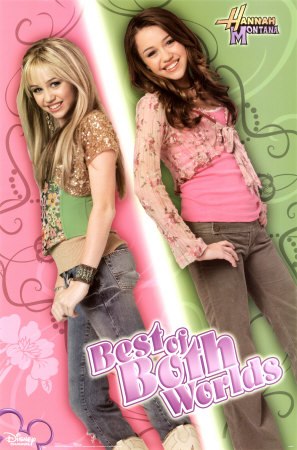
Another huge contribution to youngster's valuing of education is media, also cited by Garrison. Any child who watches television today is exposed to a nauseating extreme to "the dream of being a celebrity." Disney Channel is an extreme example and one that parents still, too frequently, fall back on as "safe" due to the mythical idealism that Baby Boomers and Gen Xers associate with Disney. The Disney Channel offering youngsters the "choice" to watch
Hannah Montana live the "Best of Both Worlds" (a story about a teenage girl living on the beach in Malibu who dawns a blonde wig and night and lives a secret life as a rock star), T
he Suite Life of Zack and Cody (rich kids who used to live in a hotel and now live on a cruise ship),
Sunny With a Chance (teenage girl who has left her family for a the chance of her life to star in a tv show in Hollywood, featuring comical scenes of classroom learning "between takes" when she can fit it in), and
iCarly (a teenager with her own webcast and national following). And let us not ignore the lack of diversity in the lead characters and perpetuation of gender stereotypes that are fostered through the viewing of these shows.
These media fiascos cultivate dreams and values within our children. They teach our children that "success" is tied to fame, rather than learning and exploring the vast possibilities that await them in a college education. And these media messages carry directly over to overly commercialized music, as well. The Pussycat Dolls' (whose recent tour was titled "Doll Domination) "
When I grow up" rants:
When I grow up
I wanna be famous
I wanna be a star
I wanna be in movies
When I grow up
I wanna see the world
Drive nice cars
I wanna have groupies
When I grow up
Be on TV
People know me
Be on magazines
When I grow up
Fresh and clean
Number one chick when I step out on the scene
And don't even get me started on their "
Don't cha wish your girlfriend was hot like me?" which, by the way, is featured on a recent
Kids Bop album sung by young girls and has also been played at my childrens' school during recess (I know this because my seven year old came home singing the lyrics). Is this our vision of role models for young girls? Is this our vision for how we want women to be valued? Today the majority of the college population is female (many of whom struggle with body image issues and eating disorders -- hmmm, wonder why). What's on the horizon for our next generation?
As you read the words on this screen, begin to shape an awareness of the role you play in fostering an education culture; you need to voice support for higher education across the board and effectively navigate our youth away from countless hours watching these media "heroes" while teaching them to actively deconstruct the messages they convey at the same time (an outcome of integrating "visual literacy" as a core 21st century skill).
We all need to crystal clear that America's success in this global, information society is contingent upon an educated population of individuals of different genders, races, and ethnicities who can think critically, offer innovative solutions to complex problems, present ideas orally and in writing, collaborate in diverse groups and demonstrate a sensitivity of cultural differences. This is fundamental to the success, both personal and economic, of our children as they emerge into adults, as well as our country. As Garrison notes,
"[F]ew among our political leaders appear to be thinking about education as a K to graduate system, and far too few appreciate the changing levels of knowledge needed to function effectively in today’s society. Once, Americans thought everyone should have around a fourth grade education, then the line gradually moved up to the eighth grade and finally to the end of high school. But the line of minimum necessity has long since crossed into higher education; now, if all you have is a high school diploma, you’re a knowledge economy dropout."
Honestly, to me, it seems that contributing to an adjustment of our culture's values of education is the one thread in this complexly interwoven ball of tangled hair that we all can directly affect starting right now.